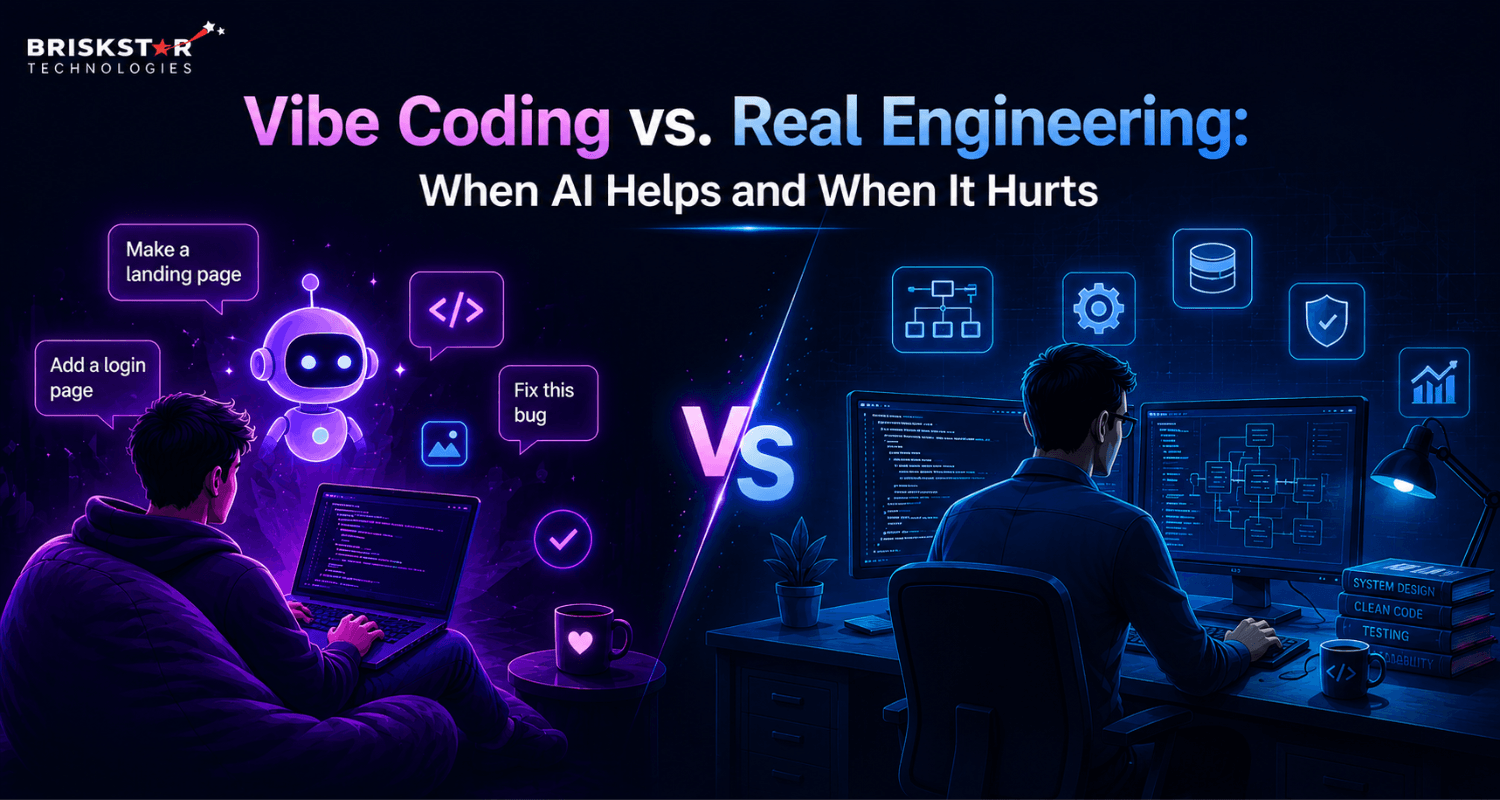
Vibe Coding vs. Real Engineering: When AI Helps and When It Hurts
A founder I spoke with last month had shipped a working payments flow in four hours using nothing but Claude and Cursor. Two weeks later, that same flow was leaking partial refunds because nobody not the AI, not the founder had accounted for what happens when a webhook fires twice. The feature worked. The system didn’t.
That gap is the whole story of AI-assisted development right now. Vibe coding describing what you want in plain language and letting an AI model generate the implementation has made it possible for a single person to build in a weekend what used to take a small team a sprint. It has also made it possible to build something that looks finished and is quietly unsound underneath.
This isn’t an argument against AI-assisted development. It’s a guide to knowing which one you’re doing at any given moment, and why that distinction is the single most important engineering decision your team will make in 2026.
What “Vibe Coding” Actually Means
The term describes a workflow, not a tool. Vibe coding is when a developer or a non-developer describes a desired outcome in natural language, an AI model generates the code, and the person accepts it based on whether it runs, not on whether they understand it.
It’s prompt-driven development taken to its logical end: the prompt is the spec, the AI is the compiler, and the human is a reviewer who often isn’t equipped to review.
This isn’t inherently bad. It’s how most people now build prototypes, internal tools, marketing pages, and one-off scripts. The problem starts when the same workflow gets applied to systems that need to survive contact with real users, real scale, and real failure modes.
Where Vibe Coding Genuinely Helps
Give credit where it’s due. Teams that use AI-assisted development well are moving faster than teams that don’t, and pretending otherwise doesn’t serve anyone.
- Prototyping and validation. Testing an idea with a working demo beats testing it with a slide deck. If the goal is to learn whether users want the thing at all, speed matters more than architecture.
- Boilerplate and scaffolding. CRUD endpoints, form validation, standard auth flows, test scaffolding this is where AI removes genuinely repetitive work without much downside.
- Internal tools. A dashboard three people on your ops team will use has a different risk profile than a product 50,000 customers depend on. Lower stakes justify a lighter process.
- Learning and exploration. Engineers use AI to understand unfamiliar codebases or languages faster than reading documentation cold. That’s a legitimate accelerant, not a shortcut.
The common thread: vibe coding works when the cost of being wrong is low and the cost of being slow is high. Reverse those two conditions, and the math changes completely.
Where It Quietly Becomes a Liability
The failure mode is rarely dramatic. Nobody’s system usually crashes on day one. What happens instead is slower and more expensive: the codebase accumulates decisions nobody made on purpose.
AI models optimize for “this satisfies the prompt,” not “this fits the system.” A generated function might work in isolation and violate every convention in the rest of the codebase: different error handling, different naming, different assumptions about what’s already validated upstream. Multiply that across a hundred AI-assisted commits and you get a codebase where no one, including the person who “wrote” it, can explain why it’s structured the way it is.
Security and edge cases get skipped by default. Ask an AI model to “build a login form” and you’ll get a login form. You won’t automatically get rate limiting, you won’t get protection against timing attacks, and you won’t get a clear answer to what happens when the database call times out mid-request. The model answers the question you asked, not the question a security review would ask.
Technical debt compounds faster, not slower. This is the counterintuitive part. AI doesn’t just create technical debt at the same rate as before it creates it faster, because the friction that used to force a conversation (a slow PR review, a teammate asking “wait, why did you do it this way?”) gets removed. Code ships before anyone has to justify it.
Nobody owns the mental model. Real engineering produces not just working code but a shared understanding of why the system is shaped the way it is. Vibe-coded systems often skip that step entirely. When something breaks at 2 a.m., the team is debugging code that reflects a conversation with an AI, not a decision anyone actually made.
None of this means AI tools are the problem. A junior engineer copy-pasting from Stack Overflow without understanding the code created the same category of risk fifteen years ago. AI just does it faster, at a much larger scale, and with far more confidence in the output.
Vibe Coding vs. Real Engineering: A Practical Comparison
| Dimension |
Vibe Coding |
Real Engineering |
| Primary goal |
Ship something that works now |
Ship something that keeps working |
| Decision driver |
Does it run? |
Does it fit the architecture, scale, and fail safely? |
| Speed to first version |
Hours |
Days to weeks |
| Ownership of logic |
Distributed between prompt and model output |
Held by the engineering team |
| Handling of edge cases |
Reactive found in production |
Proactive designed in advance |
| Best suited for |
Prototypes, internal tools, MVPs, throwaway scripts |
Customer-facing systems, regulated data, anything at scale |
| Cost of mistakes |
Low, easily reversed |
High, expensive to unwind |
| Documentation and rationale |
Often absent |
Expected and reviewed |
| Security posture |
Whatever the model defaults to |
Explicitly designed and tested |
The table isn’t a ranking. It’s a map. The question worth asking before every AI-assisted feature isn’t “should we use AI?” it’s “which column does this feature belong in?”
A Decision Framework: Should This Be Vibe-Coded or Engineered?
Run any new feature or system through these questions before deciding how much rigor it needs.
- What happens if this is wrong? A broken internal report is an inconvenience. A broken pricing calculation is a support queue and a trust problem.
- Who else depends on this code? If three other services or teams will build on top of it, the cost of an unstable foundation grows with every dependency.
- Does this touch money, identity, or regulated data? Payments, authentication, health data, and financial records deserve engineering rigor regardless of how fast you need to move.
- How long does this need to live? A script you’ll delete next week doesn’t need the same review as a service you’ll still be maintaining in three years.
- Can the team explain how it works without re-reading the code? If the honest answer is no, that’s a signal the system needs a real design pass not just a working demo.
If a feature scores “high stakes” on two or more of these, treat it as real engineering: architecture review, explicit error handling, tests written by someone who understands the failure modes, and a human who can explain every non-obvious decision.
Common Mistakes Teams Make With AI-Assisted Development
- Treating “it passed my manual test” as equivalent to “it’s production-ready.” A happy-path test tells you almost nothing about behavior under load, bad input, or partial failure.
- Letting AI-generated code skip the same review bar as human-written code. If anything, AI output deserves more scrutiny early on, until a team has calibrated where a given model tends to get things wrong.
- Using AI to generate architecture decisions, not just implementation. A model can write a function well. It has no context on your team’s operational maturity, your on-call rotation, or your actual traffic patterns decisions that should stay with the humans who own them.
- Skipping documentation because “the code is right there.” Code explains what happens. It rarely explains why, and AI-generated code is the worst offender here, since there was no human decision to record in the first place.
- Scaling a prototype without rebuilding it. The MVP that validated the idea is often the wrong foundation for the product that has to serve it at ten times the load.
Where Software Architecture Tools Actually Fit In
This is the piece most vibe-coding discussions skip. AI-assisted development doesn’t have to mean unstructured development. Modern software architecture tools dependency graphing, automated code review against defined standards, architectural decision records, contract testing between services exist precisely to catch the gap between “generated code” and “code that fits the system.”
The teams getting the most value from AI right now aren’t the ones avoiding it or the ones using it unchecked. They’re the ones that pair AI-assisted speed with the same architectural discipline they’d apply to human-written code: defined interfaces, enforced conventions, and a review process that checks for system fit, not just correctness.
Prompt-driven development scales well when the guardrails scale with it. Without those guardrails, speed just means you reach the wall faster.
When It’s Time to Bring in Engineering Expertise
There’s a specific moment most fast-moving teams hit: the AI-assisted MVP works, users are showing up, and the question becomes whether the foundation can carry the weight of real growth.
That’s usually the point where an outside architecture review earns its cost not to rewrite everything, but to identify which parts of the system need to be re-engineered before they become load-bearing for the business, and which parts are genuinely fine as they are. Getting that assessment early is almost always cheaper than getting it after an outage.
The Bottom Line
Vibe coding and real engineering aren’t opposites, and treating this as an argument about whether AI belongs in your stack misses the point entirely. AI is now a permanent part of how software gets built. The skill that separates teams that scale from teams that stall is knowing, feature by feature, which mode they’re actually operating in and having the discipline to switch modes before the stakes require it, not after.
If you’re not sure which parts of your product currently sit in which column, that’s usually the first conversation worth having with an engineering partner who’s done this before.
Frequently Asked Questions
Frequently Asked Questions About Our Blog
Vibe coding is a development approach where a person describes a desired outcome in natural language and an AI model generates the implementation, with the developer accepting output based on whether it runs rather than a full understanding of how it works.
It depends on the feature. Vibe coding is reasonable for prototypes, internal tools, and low-stakes features. For anything customer-facing, handling payments or personal data, or expected to scale, it needs to be layered with real engineering review testing, security checks, and architectural fit.
It can, and often does, because AI removes some of the natural friction like PR review or a teammate asking questions that used to catch inconsistent or unsafe code before it shipped. The debt isn't caused by the AI itself; it's caused by skipping the review step that used to happen by default.
Early-stage startups often should, for the parts of the product that exist to validate an idea. As the product gains real users and real dependencies, at least the core, high-stakes systems need engineering ownership, even if AI continues to accelerate the surrounding work.
Prompt-driven development treats natural language as the spec and AI output as the implementation. Traditional engineering treats architecture, edge cases, and system-wide consistency as first-class design decisions, made deliberately by people who understand the full system, with AI as one tool among several.
Common signals: inconsistent patterns across similar features, engineers who can't explain why certain code exists, a rising rate of production bugs tied to edge cases, and slowing feature velocity despite a growing codebase. An architecture audit can quantify this more precisely than gut feel.
Dependency graphing tools, automated linting and convention enforcement, architectural decision record (ADR) systems, and contract testing between services all help ensure AI-generated code fits the broader system rather than existing as an isolated island.
Restricting AI tools outright usually costs more in velocity than it saves in risk. A better approach is tiering: define which categories of work can move fast with AI and which require full engineering review, then make that tiering explicit to the team.
Exact costs vary by codebase and team, but the general pattern holds across software engineering: catching architectural issues during design is consistently cheaper than fixing them after they're load-bearing in a live product, because later fixes require untangling dependencies that have grown around the original decision.
Typically when a vibe-coded or AI-assisted MVP starts gaining real traction and the team needs to know which parts of the system are safe to scale as-is and which need to be rebuilt before they become a liability before an outage or security incident forces the question.