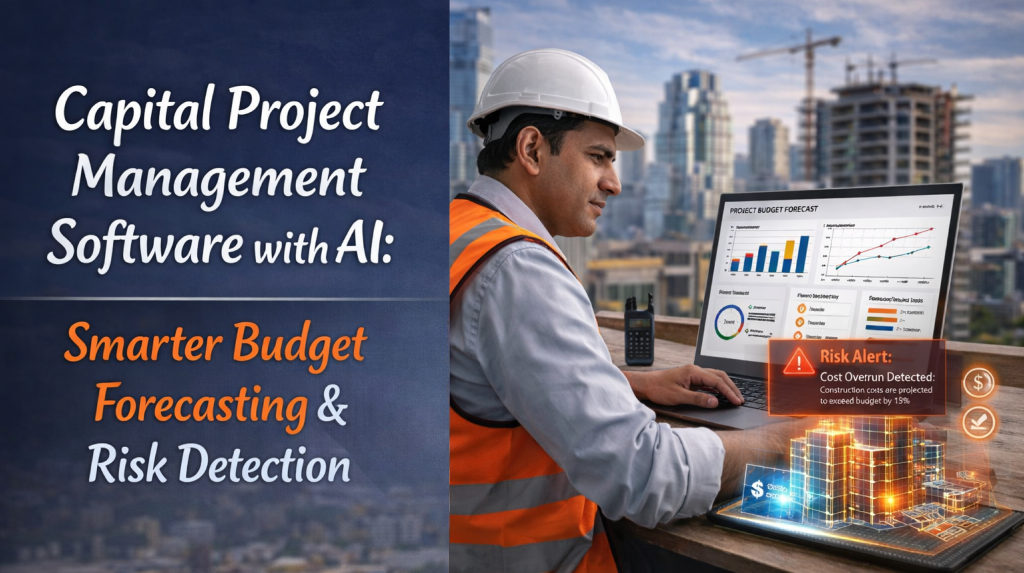
Capital Project Management Software with AI: Smarter Budget Forecasting & Risk Detection
Managing large-scale capital projects has never been simple. Whether it’s infrastructure, construction, manufacturing expansion, or energy initiatives, one challenge continues to disrupt even the most experienced teams’ uncertainty.
Budgets don’t just fluctuate; they spiral beyond projections. Timelines don’t just slip; they impact revenue, compliance, and stakeholder trust. Risks don’t arrive when they surface when it’s already expensive to fix them.
The problem? Traditional project management tools are built to track the past, not predict the future.
This is where AI-powered capital project management software is changing how modern organizations operate enabling teams to move from reactive firefighting to predictive, data-driven control.
Let’s explore how AI is reshaping budget forecasting and risk detection in capital project management.
What is Capital Project Management Software?
Capital project management software is designed to help organizations plan, execute, and monitor large-scale, high-investment projects. These platforms centralize everything from budgeting and scheduling to procurement and compliance.
However, traditional systems rely heavily on manual inputs and historical tracking.
AI changes that.
By integrating artificial intelligence in project management, modern platforms can:
- Analyze vast datasets in real-time
- Predict future outcomes
- Identify risks before they escalate
- Optimize resource allocation
Why Traditional Project Management Falls Short
Before organizations can fully appreciate the impact of AI in capital project management, it’s important to take a closer look at why traditional project management systems consistently struggle to deliver predictable outcomes.
On the surface, many conventional tools appear structured and reliable. They offer dashboards, reporting features, and planning capabilities. But when applied to complex, high-value capital projects, these systems often reveal critical limitations.
The reality is most traditional project management approaches were designed for control and documentation, not for adaptability and prediction. And in today’s fast-moving, data-driven environment, that gap becomes costly.
Let’s break down the core challenges in detail.
1. Static Budget Forecasting
Traditional project management tools approach budgeting as a one-time exercise rather than an evolving process. At the start of a project, budgets are typically created using historical data, rough estimates, and a set of assumptions that rarely hold true throughout the project lifecycle.
The problem is not the initial planning, it’s the lack of adaptability.
Once the budget is locked in, most systems require manual updates to reflect changes. And in large-scale capital projects, changes are constant. Material prices fluctuate due to market conditions, labor costs shift, and unexpected external factors like supply chain disruptions or regulatory changes can quickly impact financial planning.
Because updates are manual and often delayed, decision-makers end up relying on outdated financial data. This creates a disconnect between what is planned and what is actually happening on the ground.
Over time, small budget deviations go unnoticed until they accumulate into significant overruns. By the time leadership becomes aware, corrective actions are limited, expensive, and often too late to fully recover losses.
In high-value projects, this static approach doesn’t just reduce accuracy it increases financial risk at every stage.
2. Delayed Risk Identification
Risk management in traditional systems is largely reactive. Teams depend on periodic updates, status meetings, and manual reporting to identify potential issues. While this approach may work for smaller projects, it becomes a major limitation in complex capital initiatives.
In reality, risks don’t appear suddenly; they build over time.
A delay in procurement, a slight deviation in cost, or reduced productivity in one phase can signal a much larger problem ahead. However, traditional tools lack the capability to detect these early warning signs in real time.
As a result, risks are typically identified only after they start affecting timelines, budgets, or overall project performance.
This delay creates a costly chain reaction:
- Issues escalate before they are noticed
- Response time is reduced
- Mitigation becomes more expensive and less effective
For example, a supplier delay identified late can disrupt multiple dependent tasks, pushing timelines further and increasing operational costs. Similarly, unnoticed compliance risks can lead to penalties or project shutdowns.
Without early visibility, teams are forced into a constant cycle of firefighting responding to problems instead of preventing them.
3. Data Silos
Capital projects involve multiple stakeholders and departments, each contributing critical information to the overall execution. Finance tracks budgets, procurement manages vendors, operations oversee execution, and leadership focuses on strategic outcomes.
In traditional environments, these functions often operate in isolation.
Different teams use separate tools, spreadsheets, and reporting systems, leading to fragmented data across the organization. This lack of integration creates what is commonly known as data silos.
The impact of these silos goes far beyond inconvenience.
When data is not centralized:
- Teams work with inconsistent or outdated information
- Communication gaps increase
- Decision-making slows down
- Visibility across the project is limited
For instance, if the procurement team is aware of a delay but that information is not instantly shared with scheduling or finance, the project plan continues based on incorrect assumptions. This misalignment can cascade into missed deadlines and budget overruns.
Leaders, in turn, are forced to make decisions based on incomplete insights rather than a unified, real-time view of the project.
In large-scale capital projects, where precision and coordination are critical, siloed data becomes a major barrier to efficiency and success.
4. Lack of Predictive Intelligence
Perhaps the most defining limitation of traditional project management tools is their inability to anticipate future outcomes.
These systems are designed to report on past and present performance:
- What has been completed
- How much has been spent
- Where the project currently stands
While this information is important, it is not enough for effective decision-making in complex environments.
What organizations truly need is foresight.
Without predictive intelligence, teams cannot accurately answer critical questions such as:
- Will the project exceed its budget?
- Which activities are likely to cause delays?
- Where are potential bottlenecks forming?
- How will current decisions impact future performance?
This lack of forward-looking insight forces organizations into a reactive approach. Instead of proactively steering the project, they are constantly adjusting after problems occur.
In long-term capital projects, even minor inefficiencies can compound over time. A small delay in one phase can affect multiple downstream activities. Slight cost variations can grow into significant financial gaps.
Without the ability to predict and prepare, project management becomes less about control and more about damage limitation.
And in today’s competitive, fast-paced environment, that simply isn’t sustainable.
How AI Transforms Capital Project Management
Artificial intelligence is not just an upgrade to traditional systems, it represents a fundamental shift in how capital projects are planned, managed, and optimized. Instead of relying on hindsight and static reporting, AI introduces foresight, adaptability, and continuous intelligence into every phase of the project lifecycle.
In complex, high-investment environments, where even small inefficiencies can lead to significant losses, this shift becomes a competitive advantage.
Let’s explore how Capital Project Management Software with AI is transforming key areas of execution.
1. Intelligent Budget Forecasting
Budgeting is no longer a one-time planning activity it becomes a dynamic, continuously evolving process with AI.
AI-driven systems analyze multiple data streams simultaneously, including historical project performance, current market conditions, resource utilization patterns, and vendor behavior. Instead of relying on fixed assumptions, these systems learn from data and adjust forecasts in real time.
This approach enables AI budget forecasting that reflects the actual state of the project at any given moment.
For example, if material costs begin to rise or resource productivity drops, the system can immediately adjust projections and highlight potential budget deviations. This allows project managers to act early before small changes turn into major financial issues.
The real value lies in shifting the mindset:
- From: “What did we spend?”
- To: “What will we spend and how can we optimize it?”
With predictive cost analysis, organizations gain the ability to not just track budgets, but actively control and optimize them throughout the project lifecycle. This leads to greater financial accuracy, improved planning confidence, and reduced risk of overruns.
2. Proactive Risk Detection
In traditional environments, risk management often begins after a problem has already impacted the project. AI changes this by introducing proactive and predictive risk detection.
Using machine learning models, AI systems continuously monitor patterns, anomalies, and trends across the project. These systems are trained to recognize early warning signals that humans might overlook especially in large datasets.
This enables the software to identify potential risks such as:
- Cost overruns before they occur
- Schedule delays based on workflow patterns
- Vendor or supply chain disruptions
- Compliance or regulatory risks
Instead of waiting for issues to surface, project teams receive early alerts and actionable insights.
This fundamentally changes how organizations respond to risk:
- From reactive problem-solving
- To preventive decision-making
For instance, if the system detects a pattern indicating a likely delay in a critical task, managers can reallocate resources or adjust timelines in advance. Similarly, early identification of vendor risks allows teams to secure alternatives before operations are affected.
The result is not just fewer risks but better-controlled, predictable project outcomes.
3. Real-Time Data Insights
One of the most immediate and visible impacts of AI in capital project management is the shift to real-time intelligence.
AI-powered dashboards go beyond static reporting by providing continuously updated insights into project performance. These dashboards integrate data from multiple sources, process it instantly, and present it in a clear, actionable format.
This includes:
- Live tracking of project progress
- Predictive analytics based on current trends
- Scenario modeling to evaluate different outcomes
Decision-makers no longer need to wait for weekly or monthly reports. Instead, they have access to a live, unified view of the project, enabling faster and more informed decisions.
For example, leaders can simulate “what-if” scenarios such as changes in resource allocation or timeline adjustments and instantly understand the potential impact on cost and delivery.
This level of visibility reduces uncertainty and empowers teams to act with confidence, even in complex and rapidly changing environments.
4. Resource Optimization
Efficient resource management is critical in capital projects, where labor, equipment, and materials represent a significant portion of total costs. AI enhances this area by introducing intelligent resource optimization.
Instead of relying on manual planning or static schedules, AI systems analyze how resources are being used across the project and identify inefficiencies in real time.
This includes:
- Underutilized or overburdened labor
- Equipment downtime or overuse
- Material wastage or shortages
Based on these insights, the system can recommend optimized allocation strategies. For instance, it may suggest redistributing resources to avoid bottlenecks or adjusting schedules to improve productivity.
Over time, this leads to:
- Reduced operational waste
- Improved resource utilization
- Lower project costs
- Higher overall efficiency
More importantly, it ensures that every resource is aligned with project priorities, maximizing output without unnecessary expenditure.
Key Features of AI-Powered Capital Project Management Software
To unlock the full potential of AI in capital project management, it’s not enough to simply adopt a tool labeled “AI-powered.” The real value lies in specific capabilities that directly impact how projects are planned, monitored, and optimized.
Modern organizations should evaluate solutions based on features that go beyond basic automation features that enable intelligence, adaptability, and proactive decision-making at scale.
Here are the key capabilities that define effective AI-powered capital project management software.
Predictive Analytics Engine
At the core of any AI-driven platform is a powerful predictive analytics engine. This feature transforms raw project data into forward-looking insights that guide better decision-making.
Instead of relying solely on historical reports, the system analyzes patterns across multiple data points such as past project performance, cost trends, resource utilization, and external market conditions to forecast future outcomes with a high degree of accuracy.
This allows project leaders to:
- Anticipate budget overruns before they occur
- Identify potential delays in advance
- Understand how current performance will impact final project outcomes
For example, if productivity trends suggest that a specific phase is falling behind, the system can forecast the likely delay and its financial impact. This enables teams to take corrective action early, rather than reacting after the damage is done.
In essence, predictive analytics shifts project management from tracking performance to actively shaping outcomes.
Automated Risk Alerts
Risk management becomes significantly more effective when it is continuous and automated rather than manual and periodic.
AI-powered software continuously monitors project data in real time and identifies anomalies, patterns, or deviations that may indicate emerging risks. These insights are then translated into automated risk alerts, ensuring that teams are informed at the earliest possible stage.
Unlike traditional risk logs that depend on human input, this system works proactively by:
- Detecting unusual cost fluctuations
- Identifying schedule deviations
- Highlighting vendor performance issues
- Flagging potential compliance concerns
What makes this feature especially valuable is its timing. Early alerts give project teams the opportunity to act before risks escalate into major issues.
For instance, if the system detects a pattern that typically leads to procurement delays, it can alert managers in advance allowing them to secure alternatives or adjust timelines proactively.
This not only reduces disruption but also improves overall project stability and predictability.
Smart Scheduling
Scheduling in capital projects is rarely static. Dependencies between tasks, resource availability, and unexpected disruptions constantly affect timelines.
AI introduces a more adaptive approach through smart scheduling.
Instead of relying on fixed project timelines, AI-powered systems dynamically adjust schedules based on real-time data and evolving conditions. They analyze task dependencies, resource allocation, and progress rates to recommend optimized timelines that reflect actual project conditions.
This means:
- Delays in one phase automatically trigger adjustments in dependent tasks
- Resource conflicts are identified and resolved more efficiently
- Project timelines remain realistic and achievable
For example, if a critical task is delayed due to resource constraints, the system can suggest alternative scheduling strategies or reallocate resources to minimize the overall impact.
This level of flexibility ensures that schedules are not just plans on paper, but living frameworks that evolve with the project.
Integrated Data Ecosystem
One of the biggest barriers to effective project management is fragmented data across departments. AI-powered platforms address this challenge by creating a fully integrated data ecosystem.
This feature connects data from various functions finance, procurement, operations, engineering, and compliance into a single unified platform. By breaking down data silos, it ensures that every stakeholder has access to consistent, real-time information.
The benefits are significant:
- Improved collaboration across teams
- Faster and more accurate decision-making
- Reduced risk of miscommunication or data inconsistency
- A holistic view of project performance
For instance, when procurement updates supplier timelines, that information is instantly reflected in scheduling and financial forecasts. This level of integration eliminates delays caused by disconnected systems and manual data sharing.
In large-scale capital projects, where coordination is critical, a unified data environment becomes the foundation for efficiency and control.
Scenario Planning
Uncertainty is a constant in capital project management, but AI makes it possible to prepare for it more effectively through scenario planning.
This feature allows organizations to simulate different “what-if” scenarios and evaluate their potential impact before making decisions.
For example, teams can analyze:
- What happens if material costs increase by a certain percentage?
- How will a delay in one phase affect the overall timeline?
- What is the financial impact of reallocating resources?
AI processes these scenarios quickly, providing data-backed insights that help leaders choose the most effective course of action.
This capability is particularly valuable in high-stakes projects, where decisions often involve significant financial and operational consequences.
Instead of relying on assumptions or guesswork, organizations can make decisions based on modeled outcomes and predictive insights.
Benefits of Using AI in Capital Project Management
Adopting AI in capital project management is not just about improving processes it’s about fundamentally enhancing how organizations plan, execute, and deliver high-value projects. From financial control to operational efficiency, AI introduces measurable benefits that directly impact project success.
Let’s explore these benefits in detail.
1. Improved Budget Accuracy
Budget accuracy is one of the most critical success factors in capital projects, yet it is also one of the most challenging to maintain.
AI significantly improves financial precision by continuously analyzing real-time and historical data, rather than relying on static estimates. It takes into account multiple variables such as changing material costs, labor productivity, vendor performance, and market conditions to adjust forecasts dynamically.
This means project leaders are no longer dependent on outdated budget reports. Instead, they gain a continuously updated financial view that reflects actual project conditions.
As a result:
- Forecasting errors are minimized
- Budget deviations are identified early
- Financial planning becomes more reliable
Over time, this leads to stronger cost control and greater confidence in project investments especially in large-scale initiatives where even small inaccuracies can lead to significant financial impact.
2. Faster Decision-Making
In traditional project environments, decision-making is often delayed due to fragmented data, manual reporting, and lack of real-time visibility.
AI eliminates these barriers by providing instant, data-driven insights through centralized dashboards and intelligent analytics. Instead of waiting for weekly updates or manually compiled reports, decision-makers can access live project data at any moment.
This speed is not just about convenience it directly affects outcomes.
With faster access to accurate information, leaders can:
- Respond quickly to changes in project conditions
- Make informed adjustments to budgets and timelines
- Avoid escalation of minor issues into major problems
In fast-moving capital projects, where delays can have cascading effects, this ability to act quickly becomes a major competitive advantage.
3. Reduced Project Risks
Risk is inherent in capital projects, but AI dramatically improves how those risks are managed.
By leveraging predictive analytics and pattern recognition, AI systems can identify early warning signals that indicate potential issues. These signals may be too subtle or complex for manual detection but become visible through data-driven analysis.
This enables:
- Early identification of cost overruns
- Detection of schedule delays before they occur
- Monitoring of vendor reliability and supply chain risks
- Recognition of compliance-related concerns
Instead of reacting after a problem has already impacted the project, teams can take preventive action.
This shift from reactive to proactive risk management leads to:
- Fewer disruptions
- Lower mitigation costs
- More predictable project outcomes
Ultimately, it allows organizations to operate with greater stability and control, even in complex environments.
4. Increased Efficiency
Efficiency in capital project management is often limited by manual processes, repetitive tasks, and human dependency.
AI addresses these challenges by automating routine activities such as data collection, reporting, scheduling adjustments, and performance monitoring. This reduces the administrative burden on teams and allows them to focus on higher-value strategic work.
At the same time, AI identifies inefficiencies across the project by analyzing how resources, time, and workflows are being utilized.
This leads to:
- Reduced manual workload
- Lower chances of human error
- Faster execution of project tasks
- Better alignment between planning and execution
For example, instead of manually updating schedules or tracking progress across multiple systems, teams can rely on automated insights and recommendations.
The result is a more streamlined, productive, and responsive project environment.
5. Higher ROI
Ultimately, every capital project is evaluated based on its return on investment. AI plays a crucial role in maximizing this outcome.
By improving budget accuracy, reducing risks, optimizing resources, and enhancing decision-making, AI ensures that projects are completed more efficiently and with fewer unexpected costs.
This directly contributes to:
- Lower overall project expenditure
- Better utilization of resources
- Reduced delays and associated costs
- Improved project delivery timelines
Additionally, the ability to predict outcomes and optimize strategies throughout the project lifecycle means organizations can make smarter investment decisions from the start.
Over time, these improvements compound, leading to significantly higher returns not just on individual projects, but across the entire project portfolio.
Real-World Use Cases
The true value of AI in capital project management becomes clear when applied to real-world scenarios. Across industries, organizations are leveraging AI-powered systems not just to improve efficiency, but to gain predictive control over complex, high-investment projects.
Here’s how different sectors are using AI to transform their project outcomes.
Construction Industry
The construction industry is one of the most dynamic and risk-prone sectors when it comes to capital project management. Projects often span long timelines and involve multiple variables such as labor availability, material costs, weather conditions, and contractor coordination.
AI plays a critical role by introducing predictive intelligence into these variables.
For example, AI systems can analyze historical pricing trends, supplier data, and market conditions to predict fluctuations in material costs. This allows project managers to make informed procurement decisions such as locking in prices early or identifying alternative suppliers.
Similarly, AI can forecast labor shortages or productivity issues by analyzing workforce patterns and project timelines. If a potential shortage is identified, teams can proactively adjust hiring plans or redistribute resources.
In large construction projects, even small delays or cost changes can have cascading effects. By providing early insights, AI helps ensure projects stay on track both financially and operationally.
Infrastructure Projects
Government-led infrastructure projects such as highways, rail networks, airports, and smart cities are often large-scale, multi-year initiatives involving significant public investment.
Managing these projects requires a high level of transparency, coordination, and risk control.
AI-powered capital project management software enables governments and agencies to monitor project performance in real time. By integrating data from multiple contractors, departments, and stakeholders, these systems provide a unified view of progress, costs, and potential risks.
For instance, AI can detect early signs of delays by analyzing progress reports and comparing them with planned timelines. It can also flag budget deviations or compliance issues before they escalate into larger problems.
This proactive monitoring helps authorities:
- Prevent costly delays
- Ensure better utilization of public funds
- Maintain accountability across all stakeholders
In an environment where delays and overruns can lead to public scrutiny, AI provides a much-needed layer of control and visibility.
Energy Sector
Capital projects in the energy sector such as oil refineries, power plants, and renewable energy installations are among the most complex and high-risk initiatives.
These projects involve:
- Strict regulatory requirements
- High capital investment
- Long development cycles
- Complex supply chains
AI helps manage this complexity by providing advanced forecasting and risk analysis capabilities.
For example, in oil and gas projects, AI can monitor equipment performance and predict potential failures before they occur. This allows teams to schedule maintenance proactively, avoiding costly downtime.
In renewable energy projects, such as solar or wind farms, AI can analyze environmental data, resource availability, and construction progress to optimize project planning and execution.
Additionally, AI helps identify supply chain risks, such as delays in critical components, ensuring that project timelines are not disrupted.
By improving visibility and predictive capabilities, AI enables energy companies to execute projects more efficiently while maintaining compliance and safety standards.
Manufacturing Expansion
When manufacturing companies invest in expansion whether it’s building new facilities, upgrading production lines, or entering new markets the stakes are high. These projects require precise planning, significant capital investment, and seamless execution.
AI supports manufacturing expansion by enabling data-driven investment decisions and optimized project planning.
For instance, AI systems can forecast the financial impact of expansion projects by analyzing factors such as demand trends, production capacity, and operational costs. This helps businesses determine the most viable investment strategies.
During execution, AI helps optimize:
- Resource allocation across production units
- Equipment utilization
- Project timelines and dependencies
It can also simulate different scenarios such as changes in demand or supply chain disruptions allowing businesses to prepare for uncertainties in advance.
As a result, companies can expand with greater confidence, minimize risks, and ensure that new facilities or upgrades deliver the expected return on investment.
Challenges to Consider
While AI offers powerful advantages, implementation comes with challenges:
- Data quality and availability
- Integration with legacy systems
- Initial investment costs
- Change management and team adoption
However, these challenges are temporary compared to the long-term benefits.
How to Choose the Right AI-Powered Software
Selecting the right AI-powered capital project management solution is a strategic decision that directly impacts long-term project success. It’s not just about features, it’s about choosing a platform that aligns with your business goals, project complexity, and operational workflows.
First, scalability is critical. As capital projects grow in size and complexity, your software should be able to handle increasing data volumes, users, and multi-project environments without performance issues. A scalable system ensures you don’t outgrow your technology as your business expands.
Equally important is ease of integration. The software should seamlessly connect with your existing tools such as ERP systems, financial platforms, and procurement software so that data flows smoothly across departments. Poor integration often leads to data silos and inefficiencies.
A user-friendly interface is often underestimated but plays a major role in adoption. If the platform is complex or difficult to navigate, teams may resist using it, reducing its overall effectiveness. Intuitive dashboards and clear workflows improve productivity and decision-making.
Customization capabilities are also essential. Every organization has unique processes, and the software should adapt to your workflows not the other way around. Flexible configurations ensure the solution fits your specific project requirements.
Finally, consider vendor expertise and support. A reliable partner like Briskstar brings not only technical capability but also industry understanding, implementation guidance, and ongoing support ensuring you maximize the value of your investment.
Future of Capital Project Management with AI
The future of capital project management is not just digital it’s decisively intelligent, adaptive, and increasingly autonomous. As technologies mature, the role of AI will expand from supporting decisions to actively orchestrating project outcomes.
Advancements in machine learning, IoT integration, and cloud computing are accelerating this shift. Machine learning models are becoming more accurate with every project cycle, learning from historical data to refine predictions around cost, timelines, and risk. At the same time, IoT devices are bringing real-time visibility from the field tracking equipment performance, site conditions, and resource usage with precision. Cloud infrastructure ensures that this massive flow of data is processed instantly and made accessible across distributed teams.
Together, these technologies are shaping a new generation of capital project management software that is far more autonomous than anything seen before.
In the near future, organizations can expect:
- Self-adjusting budgets that automatically respond to market fluctuations and project performance
- Fully automated risk mitigation, where systems not only identify risks but also recommend or trigger corrective actions
- Predictive project lifecycles, offering a clear view of outcomes even before execution begins
This evolution will fundamentally change how projects are managed. Instead of constant manual oversight, teams will focus more on strategic decision-making, while AI handles complexity in the background.
Businesses that embrace this transformation early will not just improve efficiency, they will gain a measurable competitive advantage through faster execution, better cost control, and more predictable project success.
Final Thoughts
Capital project management is undergoing a fundamental transformation and as discussed throughout this guide , the shift is being driven by the growing need for accuracy, speed, and predictability in high-value projects. Traditional systems, while useful for tracking progress, fall short when it comes to adapting to real-time changes, identifying risks early, and forecasting future outcomes.
This is where AI-powered capital project management software stands out. By combining predictive analytics, real-time data insights, and intelligent automation, AI enables organizations to move beyond reactive management and toward proactive, data-driven control. From smarter budget forecasting to early risk detection, and from resource optimization to faster decision-making, AI brings a level of precision that was previously difficult to achieve.
What makes this shift even more impactful is its scalability across industries. Whether it’s construction, infrastructure, energy, or manufacturing, the ability to anticipate challenges and optimize execution is becoming a critical success factor.
However, adopting AI is not just about technology it’s about mindset. Organizations that embrace this change early are better positioned to reduce uncertainties, improve efficiency, and maximize returns on investment.
In the end, capital project success is no longer defined by how well you manage problems but by how effectively you prevent them before they occur. And with AI, that level of control is now within reach.