SaaS to AaaS Migration Consulting Services: How to Choose the Right Technology Partner
As SaaS products mature, the challenges they face begin to shift.
What once worked as a scalable and efficient delivery model can gradually become restrictive especially as user expectations evolve, systems grow more complex, and infrastructure demands increase.
Many growing SaaS businesses today are encountering similar patterns:
- Rising and often unpredictable cloud costs
- Increasing difficulty in scaling specific features independently
- Limited flexibility when integrating advanced capabilities like AI or automation
- Growing pressure to offer more customized experiences to different customer segments
These are not isolated technical issues.
They are indicators that the underlying architecture may no longer align with the direction in which the business is evolving.
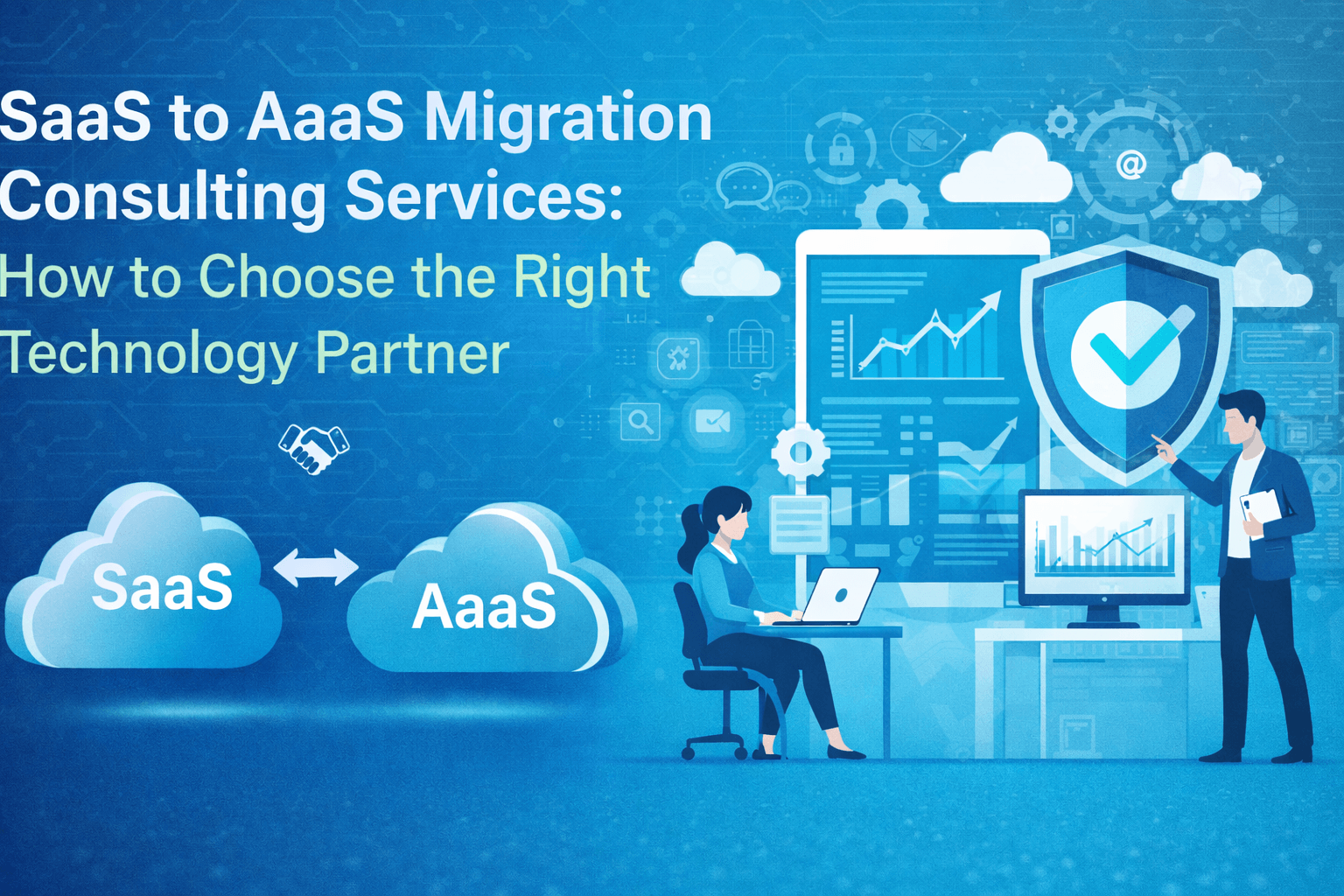
This is where the transition from Software as a Service (SaaS) to Anything as a Service (AaaS) becomes relevant.
AaaS represents a more flexible and modular approach, one that allows businesses to move beyond a single, monolithic product and instead deliver scalable, service-driven components tailored to specific needs.
However, making this transition is not simply a matter of adopting new technologies.
It requires careful planning, a clear understanding of the existing system, and most importantly, the ability to redesign architecture without disrupting ongoing operations.
This is why choosing the right SaaS to AaaS migration consulting partner becomes a critical decision.
The right partner brings not only technical expertise, but also strategic insight helping businesses navigate complexity, control costs, and build systems that are prepared for long-term scale.
In this article, we will explore what SaaS to AaaS migration truly involves, why more organizations are making this shift, and how to evaluate and select a technology partner that aligns with both your current needs and future growth plans.
What is SaaS to AaaS Migration (In Simple Words)
At its core, SaaS to AaaS migration is about evolving how your software is built, delivered, and scaled.
In a traditional SaaS (Software as a Service) model, businesses typically offer a single, structured product that is designed to serve a broad set of users. While this approach works well in the early stages, it can become limiting as customer needs diversify and systems grow more complex.
AaaS (Anything as a Service) takes a more flexible approach.
Instead of delivering one fixed product, it enables businesses to break their platform into smaller, independent services that can be scaled, modified, and consumed based on specific requirements.
This shift allows organizations to:
- Deliver features as modular, service-based components
- Scale individual services based on real-time demand
- Integrate advanced capabilities such as AI, APIs, and third-party tools more seamlessly
- Align pricing models with actual usage rather than fixed subscriptions
In practical terms, this means moving away from a “one-size-fits-all” software model toward a more adaptive, service-driven ecosystem.
And that’s exactly what SaaS to AaaS migration is about, not just changing technology, but enabling your product to grow with your business and your users.
Why Businesses Are Moving from SaaS to AaaS
The shift from SaaS to AaaS is not just a passing trend, it’s a response to how modern digital products are evolving.
As businesses scale, the limitations of traditional SaaS architectures become more visible. What once felt efficient and predictable can start creating friction across cost, performance, and flexibility.
Here are some of the key reasons driving this transition.
1. Increasing Infrastructure Costs
In many SaaS environments, infrastructure is provisioned for peak usage not actual usage.
This often leads to underutilized resources, where businesses continue to pay for idle capacity just to ensure system stability during traffic spikes.
Over time, this model becomes inefficient and difficult to control.
AaaS introduces a more optimized approach by allowing services to scale dynamically based on real demand. This helps organizations move closer to a usage-based cost structure, improving both efficiency and predictability.
2. The Need for Scalable, Independent Systems
As user bases grow, systems are expected to handle higher loads without compromising performance.
In traditional SaaS setups, scaling often requires adjustments across the entire application, which can increase complexity and slow down development cycles.
AaaS addresses this by enabling services to scale independently. Instead of scaling the entire platform, specific components can be adjusted based on demand making the system more resilient and responsive.
3. Growing Demand for Customization
Customer expectations have changed significantly.
Businesses today are no longer looking for generic, one-size-fits-all solutions. They expect platforms to adapt to their workflows, integrate with existing tools, and support unique use cases.
This level of flexibility is difficult to achieve in rigid SaaS architectures.
AaaS makes it possible by allowing features to be delivered as modular services, which can be configured, extended, or combined based on individual customer requirements.
4. Readiness for AI and Automation
The adoption of AI development, automation, and real-time data processing is accelerating across industries.
However, integrating these capabilities into traditional SaaS systems can be complex and resource-intensive, especially when the underlying architecture is not designed for it.
AaaS provides a more suitable foundation by supporting loosely coupled services and API-driven integrations. This makes it easier to introduce advanced capabilities without disrupting the entire system.
The Biggest Mistake Businesses Make
One of the most common misconceptions businesses have during SaaS to AaaS migration is assuming that it’s primarily a development task.
At first glance, this may seem logical. After all, migration involves changes to code, infrastructure, and deployment environments.
However, this perspective often leads to critical gaps in planning and execution.
SaaS to AaaS migration is not simply about rewriting code or moving systems to a different cloud environment. It is a much broader transformation that impacts how the entire platform is structured, scaled, and maintained over time.
It requires a deeper focus on areas such as:
- Redesigning the underlying architecture to support modular, service-based components
- Optimizing infrastructure usage to control long-term operational costs
- Ensuring consistent performance under varying workloads and usage patterns
- Strengthening security models to align with distributed systems and integrations
When these aspects are overlooked, businesses often encounter challenges such as unexpected cost increases, performance issues, and delays in delivering new capabilities.
This is why approaching migration as a purely technical implementation can be limiting.
What organizations truly need is not just development support, but a partner who can bring both technical execution and strategic clarity, someone who understands how to align architecture decisions with business goals.
In the context of SaaS to AaaS migration, the difference between a vendor and a technology partner can significantly influence the outcome.
Signs You Need a SaaS to AaaS Migration Partner
As SaaS products evolve, the need for architectural change often becomes visible through day-to-day operational challenges rather than a single defining issue.
In many cases, businesses continue to scale while underlying inefficiencies gradually increase until they begin to impact performance, cost, and growth potential.
Recognizing these early indicators can help organizations take a more proactive approach toward transformation.
You may want to consider engaging a SaaS to AaaS migration partner if you are experiencing challenges such as:
- A consistent increase in cloud or infrastructure costs without a proportional rise in usage or revenue
- Performance slowdowns or system instability during peak traffic periods
- Difficulty in integrating advanced capabilities such as AI, automation, or real-time data processing
- Scaling that requires manual intervention or complex workarounds
- An architecture that feels rigid when adapting to new business requirements or feature requests
- Missed opportunities or delayed deals due to limited flexibility in customization or integrations
Individually, these challenges may appear manageable. However, when they begin to occur together, they often indicate that the current SaaS architecture is no longer aligned with the business’s growth trajectory.
At this stage, bringing in the right expertise can make a significant difference not only in addressing immediate concerns but also in establishing a more scalable and future-ready foundation.
How the Right Technology Partner Changes Everything
The impact of a SaaS to AaaS migration is not determined solely by the technology used, it is largely shaped by the expertise and approach of the partner leading the transformation.
At a surface level, most migration projects may appear similar. However, the difference becomes evident in how decisions are made, how risks are managed, and how efficiently the system evolves post-migration.
When businesses move forward without the right guidance, they often encounter fragmented decision-making. Architectural choices may be made in isolation, leading to systems that are either over-engineered or not scalable enough to handle future growth.
In such scenarios, hidden costs tend to emerge over time whether through inefficient cloud usage, increased maintenance effort, or the need for rework. This not only delays progress but can also impact overall product stability and time-to-market.
In contrast, the right technology partner brings a structured and strategic approach to the entire process.
They begin with a clear understanding of the existing system and business objectives, and translate that into a well-defined migration roadmap. Architectural decisions are made with long-term scalability in mind, ensuring that the system remains flexible as requirements evolve.
Equally important is the focus on cost control and performance optimization. Instead of simply building for immediate needs, the right partner ensures that resources are used efficiently and that the platform can scale without unnecessary overhead.
This level of clarity and planning significantly reduces uncertainty, shortens development cycles, and enables faster go-to-market all while maintaining system stability.
Ultimately, the difference between the two approaches is not incremental.
It is business-defining.
Because the right partner doesn’t just help you migrate your system they help you build a foundation that supports sustainable growth.
How to Choose the Right SaaS to AaaS Migration Partner
Selecting the right partner for SaaS to AaaS migration is not just a vendor evaluation exercise, it is a strategic decision that can directly influence the success, cost efficiency, and long-term scalability of your platform.
While many agencies may offer similar services on the surface, their approach, depth of expertise, and ability to align technology with business goals can vary significantly.
To make an informed choice, it is important to evaluate partners beyond standard checklists and focus on capabilities that truly impact outcomes.
1. Look Beyond Development Evaluate Architectural Thinking
Development capability is important, but it is not the differentiator in a migration of this scale.
What matters more is the ability to rethink and redesign your system architecture for a service-based model.
A capable partner should be able to demonstrate how they would approach:
- Transitioning from monolithic to modular or microservices-based architecture
- Optimizing cloud infrastructure for performance and cost
- Designing systems that can scale without introducing unnecessary complexity
A useful way to assess this is by asking them to walk through how they would approach your current system.
Clear, structured answers indicate depth; generic responses often signal limited experience.
2. Prioritize Proven Experience Over Surface-Level Portfolios
Visual portfolios and UI showcases can be misleading when evaluating technical expertise.
For a transformation like SaaS to AaaS migration, what truly matters is real, measurable outcomes.
Look for evidence such as:
- Detailed migration case studies
- Quantifiable cost optimization results
- Performance improvements post-migration
Partners who can clearly articulate the challenges they faced, the decisions they made, and the results they achieved are more likely to deliver consistent outcomes.
3. Assess Strength in Cloud and DevOps Capabilities
AaaS architectures are inherently cloud-driven and rely heavily on automation, scalability, and system reliability.
As such, your partner should have strong, hands-on expertise in:
- Major cloud platforms such as AWS, Azure, or GCP
- Containerization and orchestration technologies
- CI/CD pipelines and automated deployment workflows
- Scalable infrastructure design and monitoring
This ensures that your system is not only built correctly but also maintained and scaled efficiently over time.
4. Evaluate Their Approach to Cost Optimization
One of the most overlooked aspects of migration is long-term cost management.
While many teams focus on building functional systems, experienced partners take a more holistic view ensuring that the architecture is efficient from both a performance and cost perspective.
This includes:
- Selecting appropriate cloud services based on actual usage patterns
- Avoiding over-engineering that leads to unnecessary overhead
- Continuously optimizing compute, storage, and network resources
A strong cost optimization mindset directly contributes to better margins and sustainable growth.
5. Look for a Clear and Structured Migration Strategy
A well-defined migration strategy is a strong indicator of a partner’s maturity and experience.
Rather than approaching the project with uncertainty, the right partner will provide:
- A phased migration roadmap aligned with business priorities
- Clear timelines and deliverables
- Identification of potential risks and mitigation plans
- Rollback strategies to ensure business continuity
This level of planning reduces ambiguity, minimizes disruption, and allows for smoother execution.
SaaS vs AaaS vs Hybrid Model (Decision Clarity)
As organizations evaluate a shift toward AaaS, one of the most common challenges is understanding which model best fits their current stage and future goals.
Rather than viewing SaaS and AaaS as mutually exclusive, it’s more helpful to see them as part of an evolving spectrum with the Hybrid model often acting as a practical transition point.
SaaS (Software as a Service)
The SaaS model is built around delivering a single, structured product to a broad user base.
It offers predictability in terms of deployment and maintenance, making it a strong choice for businesses in their early or growth stages. However, as requirements become more complex, SaaS architectures can feel restrictive particularly when it comes to customization and independent scalability.
In essence, SaaS provides stability, but with limited flexibility.
AaaS (Anything as a Service)
AaaS represents a more advanced, service-oriented approach.
Instead of relying on a single product structure, the system is broken down into modular, independent services that can be scaled, updated, and consumed based on specific needs.
This model offers significantly greater flexibility, allowing businesses to adapt quickly to changing requirements, integrate new technologies, and optimize costs through usage-based models.
AaaS is particularly well-suited for organizations aiming for long-term scalability and continuous innovation.
Hybrid Model
The Hybrid approach combines elements of both SaaS and AaaS.
Rather than moving everything at once, businesses selectively transform parts of their system into service-based components while retaining stable SaaS elements where appropriate.
This allows for a more controlled and lower-risk transition, reducing disruption while still enabling gradual modernization.
For many organizations, this becomes a strategic stepping stone balancing immediate operational stability with long-term architectural evolution.
Real-World Insight Most Blogs Won’t Tell You
In many SaaS to AaaS migration projects, the challenges are rarely caused by technology limitations.
More often, they stem from how the migration is planned and executed.
Decisions made early in the process around priorities, scope, and sequencing tend to have a far greater impact than the tools or frameworks being used.
In practice, common issues such as unclear planning, misaligned priorities, and limited architectural expertise can significantly slow down progress and introduce avoidable risks.
One of the most frequent mistakes organizations make is attempting to transform the entire system in a single phase.
While this approach may seem efficient on the surface, it often leads to increased complexity, higher risk exposure, and difficulty in maintaining system stability during the transition.
A more effective approach is to treat migration as a phased evolution rather than a one-time overhaul.
This typically involves:
- Identifying high-impact modules or services that can deliver immediate value when modernized
- Migrating these components incrementally while keeping the rest of the system stable
- Continuously validating performance, cost, and system behavior at each stage before proceeding further
This step-by-step strategy not only reduces risk but also provides better visibility into outcomes, allowing teams to make informed decisions as the migration progresses.
Our Approach to SaaS to AaaS Migration
At Briskstar, we approach SaaS to AaaS migration as a strategic transformation rather than a one-time technical activity.
The goal is not just to move systems, but to build a foundation that supports scalability, performance, and long-term efficiency.
Our process is structured to ensure clarity at every stage from initial assessment to continuous optimization.
Step 1: Deep System Audit
Every successful migration begins with a thorough understanding of the existing system.
We conduct a detailed audit to evaluate the current architecture, infrastructure utilization, and performance patterns. This helps identify inefficiencies, cost drivers, and potential risks that need to be addressed before any transformation begins.
Step 2: Migration Strategy
Based on the insights gathered, we define a clear and structured migration strategy.
This includes outlining a phased roadmap, recommending the most suitable technology stack, and assessing potential risks along with mitigation plans. The objective is to ensure that every step of the migration is aligned with business priorities and operational continuity.
Step 3: Architecture Redesign
At this stage, we focus on re-architecting the system to support a service-oriented model.
This typically involves transitioning from monolithic structures to modular, scalable components that can operate independently. The emphasis is on creating an architecture that is flexible, resilient, and capable of evolving with changing requirements.
Step 4: Implementation and Optimization
With a clear plan in place, we proceed with implementation ensuring that each component is built, deployed, and integrated efficiently.
This phase includes cloud configuration, API development, and performance tuning. Continuous monitoring during implementation allows us to identify and resolve issues early, ensuring a stable transition.
Step 5: Continuous Improvement
Migration does not end with deployment.
We continue to monitor system performance, optimize resource usage, and support ongoing scaling efforts. This ensures that the platform remains efficient, cost-effective, and ready to adapt as business needs evolve.
What Happens If You Choose the Wrong Partner
The impact of selecting the wrong technology partner during a SaaS to AaaS migration often becomes visible only after the project is underway.
At the initial stage, progress may appear steady. However, as the system evolves, gaps in planning, architecture, and execution can start to surface affecting both performance and overall business outcomes.
In such scenarios, organizations commonly experience challenges such as:
- Gradual increases in infrastructure costs due to inefficient resource utilization
- System instability or inconsistent performance under varying workloads
- Delays in delivery timelines caused by rework or architectural adjustments
- Difficulty in meeting customer expectations, leading to potential churn or missed opportunities
Individually, these issues may seem manageable. But collectively, they can significantly slow down growth and reduce the return on investment from the migration effort.
More importantly, addressing these challenges at a later stage often requires additional time, cost, and effort, sometimes exceeding what would have been required to implement the right approach from the beginning.
Final Decision Framework (Use This Before Hiring)
Before finalizing a SaaS to AaaS migration partner, it’s important to step back and evaluate the decision from both a technical and business perspective.
Rather than focusing only on capabilities or pricing, organizations should assess how well a potential partner aligns with their long-term goals, system complexity, and growth plans.
A few key questions can help guide this evaluation:
- Do they demonstrate a clear understanding of your business model and how your platform delivers value?
- Are they capable of rethinking and redesigning architecture, rather than simply executing development tasks?
- Do they incorporate cost optimization as part of their approach, not just system delivery?
- Can they showcase relevant experience in handling similar migration or transformation projects?
- Are they able to provide a structured roadmap with defined phases, timelines, and risk considerations?
These questions are not just checkpoints, they are indicators of how effectively a partner can contribute to the success of your migration.
Final Thought
SaaS to AaaS migration is not merely a technical upgrade.
It represents a broader shift in how your platform is designed, delivered, and scaled to support evolving business needs.
The decisions made during this transition particularly around architecture, strategy, and execution have a lasting impact on how efficiently your system performs and how well it adapts to future growth.
Among these decisions, the choice of the right technology partner plays a critical role.
A well-aligned partner can help streamline complexity, optimize costs, and build a system that scales with confidence. On the other hand, misaligned decisions at this stage can introduce challenges that take significant time and effort to correct.