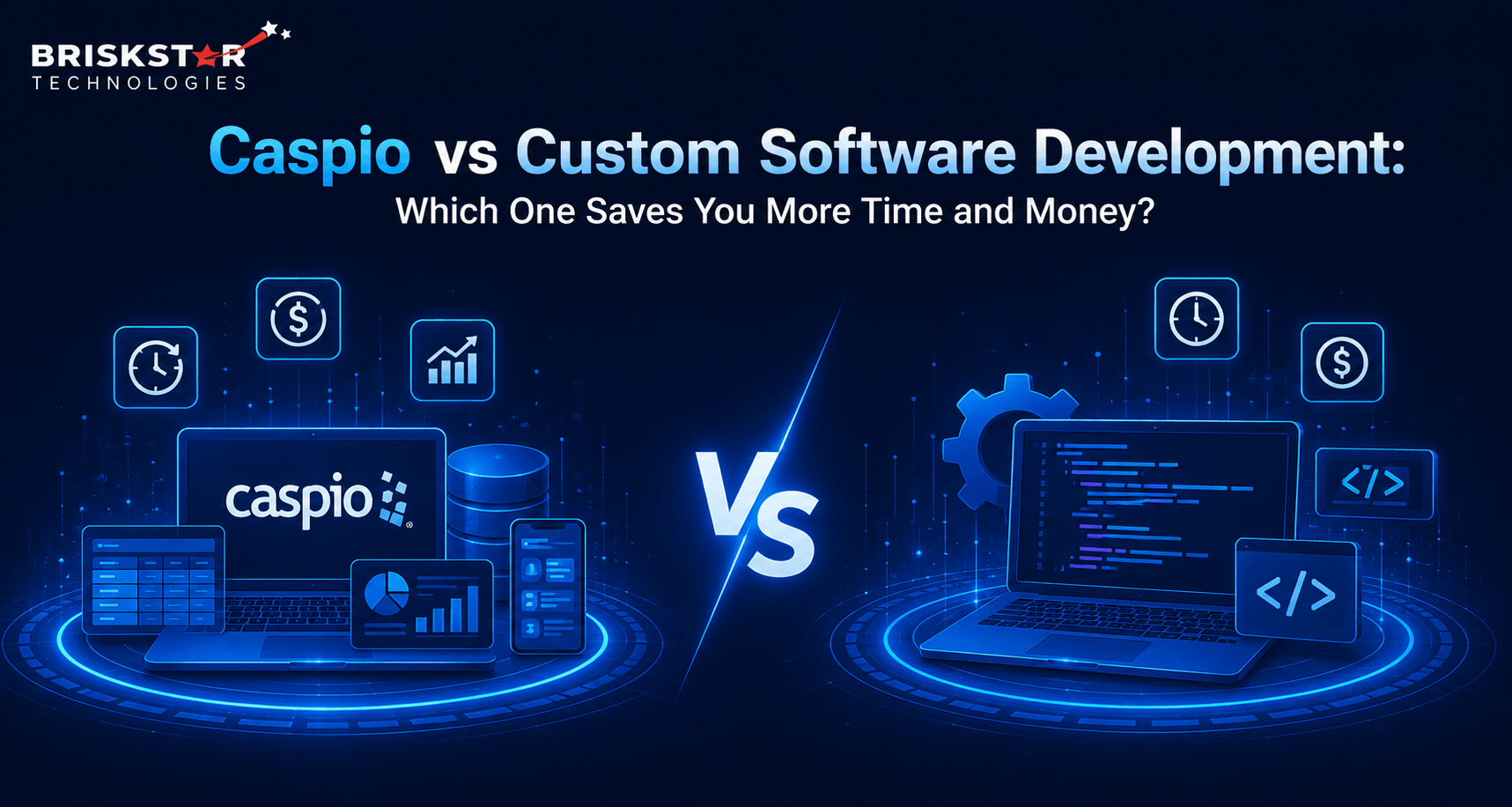
Caspio vs Custom Software Development: Which One Saves You More Time and Money?
Building business software used to mean one thing: hire developers, write thousands of lines of code, test everything, deploy it, and then keep paying a development team to maintain it.
Today, businesses have another option.
Low-code platforms such as Caspio allow companies to build database-driven business applications using visual development tools rather than creating every component from scratch. Caspio describes its platform as a way to build multi-user cloud applications with less traditional development effort and faster time-to-market.
That sounds attractive, and for many businesses, it is.
But custom software development still exists for a reason.
When a business has unique workflows, complex integrations, specialized security requirements, or software that itself is a competitive advantage, building a custom solution can provide a level of flexibility that a low-code platform cannot always match.
So, when comparing Caspio vs custom software development, which one actually saves more time and money?
The answer depends less on the price of the technology and more on what you are trying to build.
What Is Caspio?
Caspio is a low-code application development platform designed to help businesses create database-driven applications without building the entire technology stack from scratch.
Businesses can use it for applications such as:
- Internal business portals
- Customer portals
- Online forms
- Dashboards and reports
- Approval workflows
- Asset management
- Directories
- Data management systems
- CRM-style applications
- Workflow automation
Caspio provides capabilities such as visual application development, database functionality, workflow automation, integrations, REST APIs, webhooks, identity management, and reporting.
One of its notable pricing differences is that its plans provide unlimited application users rather than charging a separate license for every person using an application. Its current public pricing starts at $300/month for Team and $600/month for Business, with Enterprise pricing available by quote.
That can make Caspio particularly interesting for organizations with many employees, customers, partners, or other application users.
What Is Custom Software Development?
Custom software development means creating an application specifically for your organization’s requirements.
Instead of adapting your workflow to an existing platform, developers build the software around your processes.
A custom software project may include:
- UX/UI design
- Frontend development
- Backend development
- Database architecture
- API development
- Third-party integrations
- Authentication
- Cloud infrastructure
- Testing
- Deployment
- Monitoring
- Ongoing maintenance
This approach normally requires more time and a larger initial investment.
But the trade-off is control.
You decide how the software works, how the interface behaves, how data moves through the system, how integrations are implemented, and how the application evolves.
That difference becomes important when software is more than just an internal tool.
Caspio vs Custom Software Development: The Biggest Difference
The simplest way to understand the difference is this:
Caspio gives you a platform to build on.
Custom development gives you the freedom to build the platform itself around your requirements.
Imagine that your business needs an employee expense approval system.
Employees submit expenses.
Managers approve them.
Finance reviews them.
The system generates reports.
This is a structured business process. A low-code platform can be a very practical solution.
Now imagine you want to build a complete financial management product that connects bank accounts, accounting systems, AI-powered forecasting, payment services, mobile applications, and multiple third-party APIs.
That’s a very different problem.
The more unique and technically complex the product becomes, the stronger the case for custom software development becomes.
1. Development Time: Caspio Has the Advantage
Time is one of the strongest arguments for low-code development.
With traditional custom software development, a project typically moves through requirements, architecture, design, development, testing, deployment, and maintenance.
Even a relatively simple application can require multiple development cycles.
Caspio removes the need to build many basic components from scratch.
Its visual development environment allows teams to create applications, workflows, forms, and reports more quickly. Caspio currently states that organizations can launch solutions in weeks rather than months, depending on complexity.
This can be extremely valuable when a business needs to replace spreadsheets or manual processes quickly.
For example, a company may have 15 employees maintaining customer information across multiple Excel files.
Instead of spending months building a completely custom CRM, the company could use a low-code platform to centralize the data and create the required workflows.
If speed is your priority, Caspio can be difficult for traditional development to beat for suitable business applications.
2. Upfront Cost: Caspio Can Be More Affordable
The initial cost of custom software can be significant.
You are paying for people to design, develop, test, and deploy the application.
Depending on the project, this may involve developers, designers, QA engineers, DevOps specialists, and project managers.
Caspio reduces much of that initial engineering requirement because the platform already provides application and infrastructure capabilities.
Its current Team plan starts at $300/month, and Business starts at $600/month, with unlimited application users on the plans.
However, there is an important point here:
Caspio pricing is not the same as the total project cost.
You may still need to pay for:
- Implementation
- Application configuration
- Data migration
- Integrations
- Custom development
- Additional resources
- Training
- Ongoing administration
Caspio’s pricing page also shows additional charges for resources such as data records, storage, integrations, identity management, and other usage-based capabilities.
So the right question isn’t:
“Is Caspio cheaper per month?”
It’s:
“What will this application cost us over its expected lifetime?”
3. Customization: Custom Software Wins
This is where custom application development has a major advantage.
A low-code platform can provide significant flexibility, but you are still working within the platform’s architecture.
Custom software doesn’t have the same limitations.
You can choose:
- Your technology stack
- Your database
- Your hosting environment
- Your application architecture
- Your APIs
- Your authentication system
- Your frontend framework
- Your backend architecture
- Your AI infrastructure
- Your deployment strategy
This matters when your application needs functionality that doesn’t fit naturally into a platform.
For example, a company may require a highly customized pricing engine that evaluates hundreds of business variables in real time.
If implementing that logic requires multiple workarounds, the initial savings of low-code development can gradually disappear.
With custom software, the architecture can be designed around the requirements from day one.
4. Scalability: Look Beyond User Numbers
When businesses compare Caspio vs custom software development, scalability often becomes a major concern.
But scalability isn’t just about the number of users.
You should also consider:
- Database size
- Transaction volume
- API traffic
- Automation frequency
- Integration complexity
- Data processing
- Performance requirements
- Geographic distribution
- Future functionality
Caspio provides unlimited application users on its plans, but its plans still have different resource capacities for areas such as data records, storage, and integrations.
For many business applications, that’s perfectly reasonable.
But if your software is expected to become a highly specialized platform with significant technical requirements, custom architecture may offer more control over how the system scales.
The key is to forecast your workload, not just your user count.
5. Integrations: It Depends on Complexity
Modern software rarely works alone.
Your application may need to connect with:
Caspio supports integrations through APIs, webhooks, and extensions.
For normal business integrations, this can be more than enough.
But consider a more complicated situation.
Your application needs to:
- Receive real-time data from an external system.
- Process that data.
- Run business rules.
- Send the result to another platform.
- Trigger an AI model.
- Store the result.
- Update a mobile application.
- Notify a customer.
At that point, you’re no longer dealing with a simple integration.
You’re designing an application architecture.
That is where custom development often becomes more attractive.
6. User Experience: Custom Development Offers More Freedom
A business application doesn’t always need a highly customized interface.
If employees simply need to enter information, approve requests, and view reports, functionality may matter more than visual design.
But customer-facing software is different.
Think about:
- SaaS platforms
- E-commerce applications
- FinTech products
- Healthcare portals
- Booking platforms
- Marketplaces
- Consumer applications
In these cases, user experience can directly affect conversion and retention.
Custom software allows the entire experience to be designed around the customer journey.
You aren’t simply customizing an existing application framework.
You’re designing the experience from the ground up.
If UX is part of your competitive advantage, custom development deserves serious consideration.
7. Maintenance: Caspio Can Reduce the Technical Burden
One of the hidden costs of custom software is maintenance.
After launch, someone still needs to take care of:
- Security updates
- Server infrastructure
- Database maintenance
- Monitoring
- Backups
- Framework upgrades
- Bug fixes
- Performance
- Deployment
- Third-party dependencies
A managed platform can reduce some of that infrastructure responsibility.
Caspio provides hosted application infrastructure and positions security, compliance, database infrastructure, and application management as part of its platform.
That doesn’t mean a Caspio application requires zero maintenance.
Business rules change.
Integrations change.
Users change.
Requirements change.
But you generally don’t have to manage the entire underlying technology stack yourself.
For a small business or lean IT team, that can be a significant advantage.
8. Vendor Lock-In: Custom Software Has the Advantage
There is another cost businesses sometimes ignore:
Dependency on the platform.
If your business application becomes deeply integrated into a low-code platform, moving it somewhere else later may require considerable work.
You may need to migrate:
- Data
- Workflows
- User accounts
- Integrations
- Business rules
- Reports
- Application logic
That migration can become expensive if the application has grown significantly.
Custom software doesn’t eliminate vendor dependency entirely, but it gives your organization greater control over the architecture and technology stack.
This is particularly important if the software is expected to become a long-term strategic asset.
So, Which One Actually Saves More Money?
This is where the comparison gets interesting.
Caspio can save more money when:
- You need a straightforward business application.
- You want to launch quickly.
- Your workflow fits the platform.
- You have limited development resources.
- You don’t need highly specialized functionality.
- You want to reduce infrastructure management.
- The application is primarily an internal business tool.
Custom software can save more money long-term when:
- Your requirements are highly specialized.
- Software is a major part of your business.
- You need complete control.
- You require complex integrations.
- You expect substantial future expansion.
- Platform limitations could create expensive workarounds.
- Your application needs a highly differentiated user experience.
This is why simply comparing a monthly subscription with a development quote doesn’t work.
You need to compare the Total Cost of Ownership (TCO).
A Simple Example
Imagine a company needs an employee request management system.
Employees submit requests.
Managers approve them.
Operations process them.
Management sees dashboards.
For this type of application, custom development may be unnecessary.
A low-code platform can potentially deliver the required functionality faster and with less engineering effort.
Now change the requirements.
The company wants to turn the same system into a commercial SaaS product.
Customers will pay for it.
It needs:
- Mobile apps
- AI automation
- Complex billing
- Real-time notifications
- Multiple external APIs
- Custom analytics
- Advanced permissions
- Unique workflows
- High-performance infrastructure
Now custom development starts making much more sense.
The lesson isn’t that Caspio is better or that custom software is better.
The lesson is that the architecture should match the business model.
When Should You Choose Caspio?
Caspio is a strong candidate when you’re solving an operational problem rather than building a technology product.
For example:
“We need to replace our spreadsheets.”
“We need an internal approval workflow.”
“We need a customer portal.”
“We need a searchable database.”
“We need a reporting dashboard.”
“We need to digitize this manual process.”
These are situations where speed and efficiency can be more important than owning every layer of the technology.
Caspio itself highlights use cases including custom CRM systems, web dashboards, web forms, approval workflows, asset management, and knowledge bases.
When Should You Choose Custom Software Development?
Custom software becomes more attractive when you hear statements like:
“Our process is completely different from other companies.”
“This software is going to be our product.”
“We need functionality that existing platforms don’t provide.”
“Our integrations are extremely complex.”
“We need complete control over the architecture.”
“The application will become a major revenue channel.”
These are signs that the software itself may deserve custom engineering.
The Best Decision Isn’t Always Either/Or
There is also a third approach.
Some businesses can use a hybrid strategy.
For example, you could use a low-code platform for internal administrative workflows while custom-building the customer-facing product.
Or you could use an existing platform for an MVP, validate the idea, and later invest in custom software once the requirements are proven.
This can reduce the risk of spending a large amount of money before you know whether the product actually works for your users.
However, this strategy should be planned carefully.
If you already know that the final application will require a completely different architecture, building a temporary solution may simply mean paying twice.
Caspio vs Custom Software Development: Final Verdict
There isn’t a universal winner.
Caspio wins when speed, simplicity, and lower initial development effort are the priority.
Custom software wins when flexibility, ownership, advanced functionality, and long-term control matter more.
If you’re building an internal business application, Caspio may give you exactly what you need without the cost and complexity of traditional development.
If you’re building a software product that will differentiate your company, generate revenue, or require highly specialized functionality, custom software development may deliver more value over time.
The smartest decision is therefore not:
“Which one is cheaper?”
It’s:
“Which option will help us achieve our business goals with the lowest total cost and least unnecessary complexity?”
Before making the decision, calculate your expected three-to-five-year costs, consider future requirements, and identify which capabilities are genuinely business-critical.
Because saving money today doesn’t mean much if you have to rebuild the entire application lo two years.
And spending more upfront isn’t a problem if the software becomes a long-term competitive advantage.
Choose the technology based on the business problem, not the other way around.
Need Help Choosing Between Caspio and Custom Software?
The wrong technology decision can become expensive when your application grows beyond its original capabilities.
Before choosing a platform or starting development, evaluate your requirements, integrations, scalability, user experience, and long-term roadmap.
Talk to our software development experts to determine whether Caspio, custom development, or a hybrid approach makes the most sense for your business.
Frequently Asked Questions About Our Blog
For straightforward business applications, Caspio can be less expensive because it reduces the amount of custom engineering and infrastructure work. However, implementation, integrations, resource usage and ongoing platform costs should also be included when calculating the total cost.
Yes. Caspio is specifically designed for database-driven business applications, including dashboards, forms, workflows, portals, and other operational tools.
Not necessarily. Custom development provides more flexibility, while low-code development can deliver suitable applications faster and with less engineering effort. The better choice depends on complexity and long-term requirements.
Caspio provides unlimited application users across its plans and supports scalable cloud infrastructure, while different plans provide different resource capacities. Businesses should evaluate their expected data, integrations, and workload before selecting a plan.
Custom software is usually worth considering when the application has unique business logic, complex integrations, advanced performance requirements, a highly customized user experience, or when the software itself is a major competitive advantage.
The biggest advantage is speed and reduced development complexity. Its visual development approach allows businesses to build applications without creating every underlying component from scratch.
The biggest advantage is control. Your development team can design the architecture, functionality, user experience, and integrations specifically around your business requirements.
The wrong technology decision can become expensive when your application grows beyond its original capabilities.
Before choosing a platform or starting development, evaluate your requirements, integrations, scalability, user experience, and long-term roadmap.