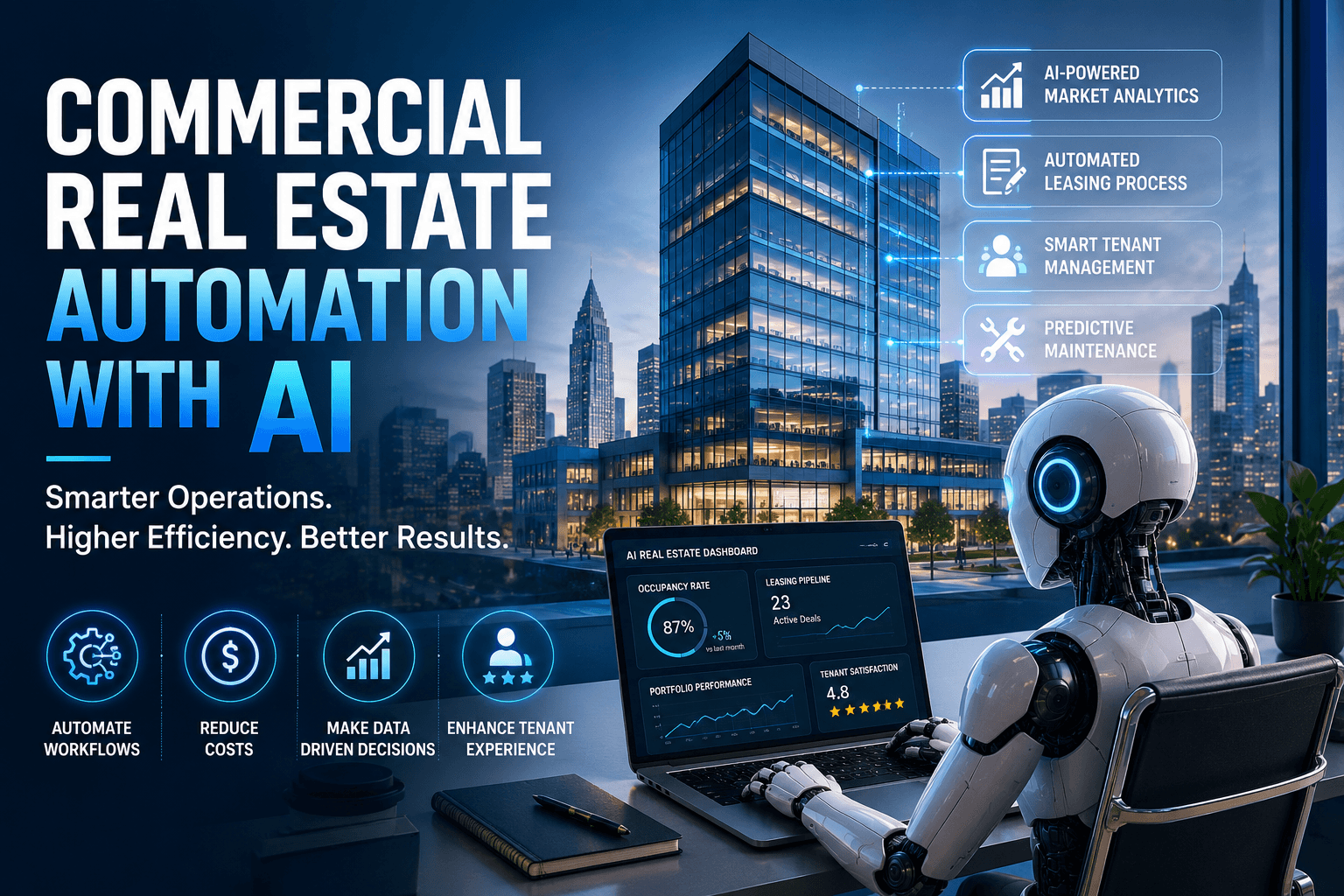
Commercial Real Estate Automation with AI
Commercial real estate (CRE) has traditionally been a relationship-driven, manual, and time-intensive industry. From property discovery and tenant management to deal closures and maintenance operations, most processes relied heavily on human effort, spreadsheets, and fragmented systems.
But that reality is changing fast.
With the rise of Artificial Intelligence (AI), commercial real estate is entering a new era of automation, intelligence, and efficiency. Today, forward-thinking real estate companies are leveraging AI to streamline operations, improve decision-making, and deliver highly personalized experiences to tenants, buyers, and investors.
What used to take weeks like property matching, lead qualification, or lease analysiscan now be done in minutes with AI-powered automation.
The shift is clear:
Automation is no longer a luxury in CREit’s a necessity for survival and growth.
What is Commercial Real Estate Automation with AI?
Commercial Real Estate Automation with AI refers to the use of advanced technologies such as machine learning, natural language processing, and predictive analytics to automate and optimize real estate processes.
Unlike traditional automation (which follows fixed rules), AI-powered systems can:
- Learn from data
- Adapt to user behavior
- Make predictions
- Continuously improve over time
Key Technologies Behind AI Automation
- Machine Learning (ML): Enables systems to learn from historical data and predict future trends (e.g., pricing, demand)
- Natural Language Processing (NLP): Helps in analyzing documents like leases, contracts, and emails
- Computer Vision: Used for property image analysis and virtual tours
- Predictive Analytics: Forecasts market trends, tenant behavior, and investment opportunities
Simple Example
Traditional system:
User filters properties → scrolls → manually selects
AI-powered system:
System understands user intent → recommends best-fit properties automatically
This shift from search to matchmaking is where AI delivers massive value.
Key Areas Where AI is Transforming Commercial Real Estate
Artificial Intelligence is no longer just an innovation in commercial real estateit’s becoming the backbone of modern property operations. From discovering the right property to managing leases and ensuring compliance, AI is reshaping every stage of the real estate lifecycle. Below are the most impactful areas where AI is driving real transformation.
1. Property Search & Matchmaking
Traditional property search methods rely heavily on static filters such as location, budget, and property type. However, these filters often fail to capture the real intent of users, leading to irrelevant listings and wasted time.
AI changes this by turning property search into a personalized experience. It analyzes user behaviorsuch as search patterns, clicks, and preferences to understand what the user actually needs. Based on this data, AI delivers highly relevant property recommendations that improve over time.
This intelligent matchmaking not only enhances user satisfaction but also increases the chances of conversion by connecting users with properties that truly fit their requirements.
2. Lead Generation & Qualification
Generating and managing leads manually is both time-consuming and inefficient. Real estate businesses often struggle with delayed responses and unqualified leads.
AI-powered systems solve this by automating the entire lead lifecycle. Chatbots can capture and engage leads 24/7, ensuring no opportunity is missed. At the same time, AI evaluates user behavior to score leads based on their intent and readiness to convert.
This allows sales teams to focus only on high-quality prospects, improving productivity and increasing deal closure rates while also providing faster and more personalized responses to potential clients.
3. Property Valuation & Investment Analysis
Accurate property valuation is critical for making informed investment decisions. Traditional methods often rely on outdated data and manual comparisons, which can lead to errors.
AI enhances valuation by analyzing large volumes of data, including historical prices, market trends, and location demand. It also uses predictive analytics to forecast future property values and identify investment opportunities.
This data-driven approach helps investors and businesses reduce risks, optimize pricing strategies, and make smarter decisions based on real-time insights rather than assumptions.
4. Lease Management Automation
Lease agreements are complex and require careful tracking of multiple terms, deadlines, and conditions. Managing them manually increases the risk of missed renewals and compliance issues.
AI simplifies lease management by automatically extracting key information from documents using advanced language processing. It tracks important dates such as renewals and expirations and sends timely alerts to stakeholders.
By reducing manual effort and minimizing errors, AI ensures better compliance and allows real estate professionals to manage multiple leases more efficiently.
5. Property Management & Maintenance
Managing commercial properties involves handling maintenance requests, monitoring systems, and ensuring tenant satisfaction. Traditional approaches are often reactive, leading to higher costs and inefficiencies.
AI enables a proactive approach through predictive maintenance and real-time monitoring. By integrating with IoT devices, AI can detect potential issues before they become major problems. It also automates tenant request handling and optimizes energy consumption.
This results in reduced operational costs, improved tenant experience, and more efficient property management overall.
6. Document Processing & Compliance
Commercial real estate involves extensive documentation, including contracts, legal papers, and compliance records. Manual processing of these documents is slow and prone to errors.
AI streamlines this process by digitizing documents and extracting structured data using OCR and advanced algorithms. It also automates compliance checks to ensure all regulations are met.
This significantly reduces processing time, improves accuracy, and accelerates due diligence, enabling faster and more reliable transactions.
Benefits of AI Automation in Commercial Real Estate
Artificial Intelligence is not just improving processes in commercial real estate, it’s fundamentally changing how businesses operate, compete, and scale. By automating repetitive tasks and introducing data-driven intelligence, AI delivers measurable benefits across the entire real estate lifecycle.
1. Faster Deal Closures
In traditional commercial real estate, deal cycles can be slow due to manual processes, delayed communication, and fragmented data. Tasks such as property matching, document verification, and lead follow-ups often create bottlenecks.
AI accelerates these processes by automating repetitive and time-consuming tasks. From instantly matching buyers with relevant properties to automating communication and document handling, AI significantly reduces delays. Real-time insights also enable quicker decision-making.
Result: Faster deal closures, reduced turnaround time, and improved business efficiency.
2. Cost Reduction
Operational costs in commercial real estate can be high due to manual labor, administrative work, and inefficient processes. Managing properties, handling documentation, and maintaining communication channels require significant resources.
AI automation reduces these costs by minimizing the need for manual intervention. Tasks like data entry, document processing, and customer support can be handled by intelligent systems, allowing businesses to operate with leaner teams.
Result: Lower operational expenses and better resource utilization without compromising productivity.
3. Improved Lead Conversion
One of the biggest challenges in real estate is converting leads into actual clients. Traditional methods often involve generic communication and delayed responses, which can result in lost opportunities.
AI enhances lead conversion by delivering personalized experiences. It analyzes user behavior and preferences to provide targeted property recommendations and timely follow-ups. Automated lead scoring ensures that high-intent prospects are prioritized.
Result: Higher conversion rates, better engagement, and increased revenue opportunities.
4. Data-Driven Decisions
Real estate decisions have traditionally relied on intuition and limited data. This can lead to inaccurate pricing, poor investment choices, and missed opportunities.
AI changes this by providing actionable insights based on large datasets. It analyzes market trends, customer behavior, and property performance to support informed decision-making. Predictive analytics further helps businesses anticipate future trends.
Result: More accurate decisions, reduced risks, and improved strategic planning.
5. Enhanced Customer Experience
Modern customers expect fast, personalized, and seamless experiences. Traditional systems often fail to meet these expectations due to delays and lack of customization.
AI improves customer experience by offering instant responses, personalized property recommendations, and smooth interactions across platforms. Chatbots, smart search systems, and automated communication ensure users get what they need quickly.
Result: Higher customer satisfaction, stronger relationships, and increased brand trust.
6. Scalability
As real estate businesses grow, managing more properties, clients, and transactions becomes increasingly complex. Scaling operations manually often leads to higher costs and inefficiencies.
AI enables seamless scalability by automating core processes and handling large volumes of data and interactions without additional overhead. Whether it’s managing hundreds of properties or thousands of leads, AI systems can scale effortlessly.
Result: Business growth without proportional increases in cost or complexity.
Real-World Use Cases of AI in CRE
Artificial Intelligence is actively transforming commercial real estate by improving efficiency, decision-making, and user experience across multiple areas.
1. AI-Powered Property Platforms
Modern property platforms use AI to deliver personalized property recommendations based on user behavior, search history, and preferences. Instead of showing generic listings, these platforms match users with relevant properties, improving engagement and increasing conversion rates.
2. Smart CRM Systems
AI-driven CRM systems automate lead management by tracking user interactions, scoring leads based on intent, and triggering follow-ups automatically. This helps sales teams focus on high-quality prospects and improves overall sales efficiency.
3. Predictive Maintenance Systems
AI combined with IoT sensors enables real-time monitoring of building systems. It detects potential issues before they become major problems, allowing for proactive maintenance. This reduces downtime, lowers repair costs, and enhances tenant satisfaction.
4. Investment Intelligence Tools
AI-powered tools analyze large volumes of data, including market trends, pricing history, and location demand, to identify profitable investment opportunities. They also provide risk assessments and future predictions, helping investors make smarter decisions.
Challenges in Implementing AI in Commercial Real Estate
While AI brings significant advantages to commercial real estate, its implementation is not without challenges. Businesses must address several barriers to fully unlock its potential.
1. Data Quality Issues
AI systems depend heavily on accurate, clean, and structured data. In many real estate organizations, data is scattered, outdated, or inconsistent. Poor data quality can lead to inaccurate insights, flawed predictions, and unreliable automation outcomes.
2. Integration with Legacy Systems
Many commercial real estate firms still rely on outdated software and manual processes. Integrating modern AI solutions with these legacy systems can be complex, time-consuming, and technically challenging, often requiring system upgrades or custom development.
3. Initial Investment Cost
Implementing AI involves upfront costs, including technology infrastructure, skilled professionals, and system integration. For some businesses, especially smaller firms, this initial investment can be a major barrier despite long-term benefits.
4. Resistance to Change
Adopting AI requires a shift in mindset and workflows. Traditional brokers and teams may resist new technologies due to lack of understanding or fear of disruption, slowing down adoption and implementation.
5. Privacy & Compliance Concerns
Handling sensitive data such as client information, financial records, and contracts requires strict security measures. Businesses must ensure compliance with data protection regulations to avoid legal risks.
How to Implement AI Automation in Commercial Real Estate
Implementing AI automation in commercial real estate is not just about adopting new technology it requires a strategic, step-by-step approach to ensure long-term success. When done correctly, AI can streamline operations, improve decision-making, and significantly boost efficiency.
Step 1: Identify Business Pain Points
The first step is to clearly understand where AI can create the most impact. Analyze your existing workflows and identify inefficiencies in areas such as lead generation, property management, and sales processes. For example, if your team spends too much time qualifying leads or managing maintenance requests, these are strong opportunities for automation. A focused approach ensures better results and faster ROI.
Step 2: Choose the Right AI Solutions
Once the pain points are identified, the next step is selecting the right AI tools. Businesses can choose between custom-built solutions tailored to their specific needs or SaaS platforms that offer quicker deployment and lower initial costs. The decision should be based on scalability, integration capabilities, and long-term business goals.
Step 3: Data Collection & Preparation
AI systems rely heavily on data, making this one of the most critical steps. Ensure that your data is clean, structured, and centralized. This includes property data, customer interactions, transaction history, and operational records. High-quality data enables accurate predictions and effective automation.
Step 4: Integration with Existing Systems
For AI to deliver maximum value, it must be integrated seamlessly with your existing systems such as websites, mobile apps, CRM, and ERP platforms. Proper integration ensures smooth data flow, eliminates silos, and enhances overall operational efficiency.
Step 5: Continuous Optimization
AI systems improve over time, but only with regular monitoring and refinement. Track performance, analyze user behavior, and update models to improve accuracy and outcomes. Continuous optimization ensures that your AI solutions remain effective as your business grows.
Future Trends in AI for Commercial Real Estate
The future of commercial real estate (CRE) is rapidly evolving, and Artificial Intelligence is set to play a central role in shaping how the industry operates. As technology advances, AI will move beyond basic automation to deliver highly intelligent, predictive, and autonomous solutions.
1. Hyper-Personalized Property Matchmaking
AI will take property recommendations to the next level by delivering hyper-personalized experiences. By analyzing deep user behavior, preferences, and business needs, AI systems will match users with properties that perfectly align with their goals. This will significantly reduce search time and improve decision-making accuracy.
2. Voice-Based Property Search
With the rise of voice assistants, property search will become more conversational and user-friendly. Users will be able to search for commercial properties using natural language commands, making the process faster and more accessible, especially on mobile devices.
3. AI-Powered Virtual Tours
Virtual tours will become more advanced and interactive with AI integration. Instead of static walkthroughs, users will experience intelligent tours that adapt to their interests, highlight key features, and answer questions in real time, creating a more immersive property viewing experience.
4. Digital Twins
Digital twinsvirtual replicas of physical buildings will transform property management and planning. These AI-powered models will allow real estate professionals to simulate scenarios, monitor performance, and optimize maintenance strategies, leading to better operational efficiency and cost savings.
5. Autonomous Real Estate Platforms
The future will see the rise of fully automated real estate platforms that handle everything from property listing and lead generation to negotiation and deal closure. These platforms will reduce human intervention, speed up transactions, and create a seamless end-to-end experience.
Why Businesses Should Invest in AI Automation Now
- Early adopters gain a strong competitive advantage
- Customer expectations are rapidly evolving
- AI reduces long-term operational costs
- Competitors are already adopting AI technologies
Delaying AI adoption can mean losing market share to more innovative players.
How AI Automation Can Drive Growth for Your Real Estate Business
In today’s competitive commercial real estate market, growth depends on how efficiently you manage leads, operations, and customer experiences. AI automation provides a powerful way to streamline processes and unlock new opportunities for scaling your business.
Generate High-Quality Leads Automatically
AI-powered systems can capture and analyze leads in real time through chatbots, smart forms, and user behavior tracking. By identifying high-intent prospects, AI ensures your sales team focuses only on leads that are more likely to convert, improving overall efficiency and results.
Improve Customer Experience
Modern clients expect fast, personalized interactions. AI enables this by delivering tailored property recommendations, instant responses to queries, and seamless communication across platforms. This creates a more engaging and satisfying experience for buyers, tenants, and investors.
Close Deals Faster
AI reduces delays by automating repetitive tasks such as follow-ups, document processing, and property matching. With quicker insights and faster communication, businesses can shorten the sales cycle and close deals more efficiently.
Optimize Operations
From property management to maintenance and reporting, AI helps automate day-to-day operations. Predictive analytics and real-time monitoring allow businesses to reduce inefficiencies, lower costs, and improve overall performance.
Scale Without Increasing Costs
One of the biggest advantages of AI is scalability. As your business grows, AI systems can handle more properties, clients, and transactions without requiring significant increases in manpower or resources.
Ready to Transform Your Real Estate Business with AI?
If your commercial real estate business is still relying on manual processes, you’re missing out on faster growth, better leads, and higher efficiency. AI automation is no longer optional it’s the key to staying competitive in today’s market.
At Briskstar, we help real estate businesses unlock the full potential of AI with custom-built, scalable solutions designed for real results.
Whether you want to generate high-quality leads automatically, improve customer experience, or close deals faster, our AI-driven systems are built to deliver measurable impact. From smart property matchmaking and AI-powered CRM to predictive analytics and automated operations we create solutions tailored to your business goals.
Our team works closely with you to understand your challenges, integrate AI seamlessly into your existing systems, and ensure long-term scalability without increasing operational costs.
Don’t let outdated processes slow you down.
It’s time to move smarter, faster, and ahead of your competition.
Book a Free Consultation Today. Get a Custom AI Strategy for Your Business
Let’s build a future-ready, AI-powered real estate business together.
Conclusion
Commercial real estate is undergoing a massive transformation and AI is at the center of it.
From property search and lead generation to maintenance and investment analysis, AI-powered automation is redefining how the industry operates.
Businesses that embrace this shift will:
- Operate more efficiently
- Deliver better customer experiences
- Make smarter decisions
- Achieve faster growth
Those who don’t risk falling behind.