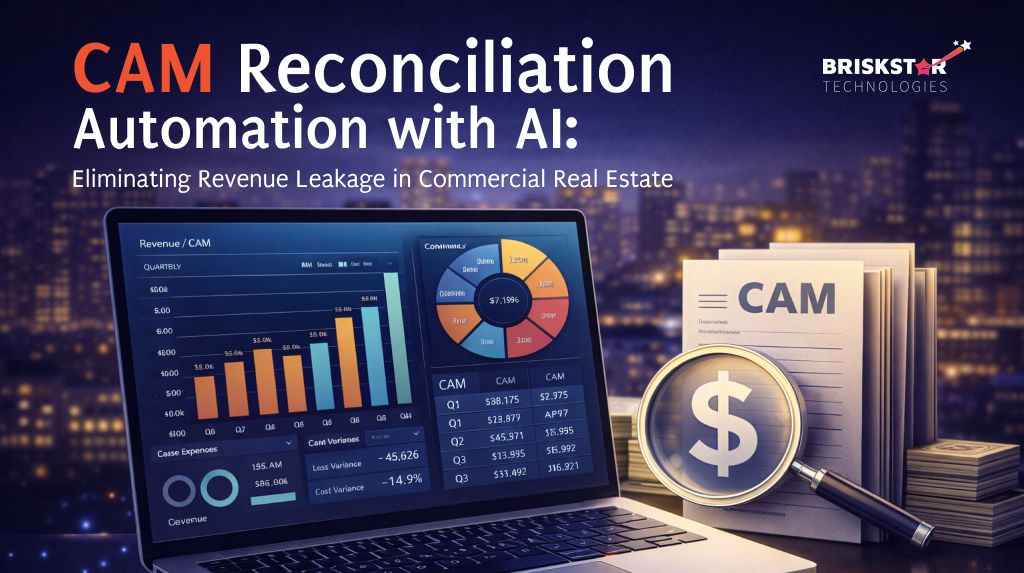
CAM Reconciliation Automation with AI: Eliminating Revenue Leakage in Commercial Real Estate
Commercial real estate has never been simple. From managing multiple properties to handling tenants, vendors, and operational costs, the industry operates within a highly complex environment. Among all these processes, one area that consistently creates challenges and often goes unnoticed is Common Area Maintenance (CAM) reconciliation.
Most property owners and asset managers are already familiar with the situation.
You bill tenants for shared expenses such as maintenance, utilities, taxes, and insurance. However, the process behind calculating, tracking, and reconciling these costs is often manual, fragmented, and prone to errors.
The reality is straightforward but critical:
Even small inefficiencies in CAM reconciliation can lead to measurable revenue leakage over time.
When these inefficiencies are repeated across multiple properties, tenants, lease agreements, and financial cycles, the financial impact becomes significant. This is where AI-driven CAM reconciliation automation is emerging as a practical and scalable solution.
What is CAM Reconciliation (And Why It’s So Critical)?
CAM (Common Area Maintenance) reconciliation is a core financial process in commercial real estate that ensures shared operating expenses of a property are accurately calculated, allocated, and recovered from tenants based on the terms defined in their lease agreements.
In most commercial properties such as office buildings, retail centers, and industrial parks there are certain areas and services that are used collectively by all tenants. These may include lobbies, parking lots, elevators, landscaping, security services, lighting, and general maintenance. The costs associated with maintaining these shared spaces are not borne solely by the property owner. Instead, they are distributed among tenants, typically in proportion to the space they occupy or as defined in their lease.
Throughout the year, tenants are usually billed an estimated CAM charge. This estimate is based on projected expenses for maintenance, utilities, insurance, property taxes, and other operational costs. However, since these are only projections, they rarely match the actual costs incurred.
This is where CAM reconciliation becomes necessary.
At the end of a financial period usually annually the property owner or asset manager performs CAM reconciliation to compare the estimated charges billed to tenants with the actual expenses incurred during that period. The goal is to identify any differences and make the necessary financial adjustments.
If the actual expenses are higher than what was initially billed, tenants are required to pay the difference. Conversely, if the estimated charges exceed the actual expenses, tenants are issued credits or refunds. This process ensures that cost recovery is accurate and fair for both parties.
Why Traditional CAM Reconciliation Fails
In many commercial real estate organizations, CAM reconciliation continues to rely on legacy processes that were never designed for today’s level of operational complexity. While spreadsheets, emails, and manual workflows may appear manageable at a smaller scale, they quickly become inefficient and error-prone as portfolios expand and lease structures grow more sophisticated.
Most traditional CAM reconciliation processes are built on a combination of:
- Spreadsheet-based calculations
- Email-driven communication and approvals
- Manual data entry and validations
- Multiple disconnected financial and operational systems
These methods create hidden inefficiencies that impact accuracy, transparency, and overall financial performance. Below are the key reasons why traditional CAM reconciliation fails to meet modern business requirements.
1. Manual Data Entry
Manual data entry is one of the most fundamental limitations of traditional CAM reconciliation processes. In most commercial real estate operations, financial data such as vendor invoices, maintenance expenses, utility bills, and tax records must be manually collected, entered, and processed. This creates a heavy dependency on human effort at every stage of the workflow.
The primary issue with manual data handling is the high probability of errors. Even experienced professionals can make mistakes when dealing with repetitive tasks and large volumes of data. Common issues include incorrect data input, duplicate entries, missing values, and inconsistent categorization of expenses. Since CAM reconciliation involves aggregating data from multiple sources, even a small error in one entry can impact the entire calculation.
Another challenge is the difficulty in identifying and correcting these errors. Data is often stored across multiple spreadsheets or systems, making it hard to trace discrepancies back to their source. By the time errors are discovered, they may have already affected billing cycles or financial reports, requiring additional time and effort to fix.
Over time, these inaccuracies lead to missed recoverable expenses, incorrect tenant billing, and financial discrepancies that often go unnoticed. As portfolios grow and data volume increases, the reliance on manual processes becomes a major risk factor for both operational efficiency and revenue accuracy.
2. Lease Complexity
Lease complexity is another major reason why traditional CAM reconciliation processes struggle to deliver consistent and accurate results. In commercial real estate, lease agreements are rarely standardized. Each tenant may have a unique contract with specific terms that define how shared expenses should be allocated and recovered.
These lease agreements often include detailed conditions such as caps on expense increases, exclusions for certain cost categories, pro-rata share calculations based on square footage or usage, and customized recovery rules. Managing these variations manually requires careful review and interpretation of each lease document.
The challenge increases significantly when dealing with multiple properties and tenants. Teams must apply different rules for each lease while ensuring accuracy and consistency across all calculations. This process is not only time-consuming but also highly prone to human error.
Even minor misinterpretations of lease clauses can lead to incorrect cost allocations, which may result in underbilling or overbilling. This not only impacts revenue but also creates the potential for tenant disputes and dissatisfaction.
As the number of leases grows, maintaining consistency becomes increasingly difficult. Traditional methods lack the ability to handle this level of complexity at scale, making it nearly impossible to achieve accurate and standardized reconciliation outcomes.
3. Lack of Standardization
A lack of standardization is a common issue in traditional CAM reconciliation processes, especially in organizations managing multiple properties or large portfolios. Without a unified approach, different teams often follow their own methods for handling data, calculations, and reporting.
This inconsistency can be seen in the use of different spreadsheet formats, calculation techniques, naming conventions, and reporting structures. As a result, financial data becomes fragmented and difficult to manage.
In addition to process inconsistency, data is often stored across multiple systems such as accounting software, property management platforms, and internal databases. These systems may not be fully integrated, leading to data silos and disconnected workflows.
The absence of a centralized system creates a significant challenge: there is no single source of truth. Teams must spend considerable time reconciling data between systems, verifying accuracy, and resolving discrepancies.
This not only increases the workload but also reduces confidence in the data. Inconsistent processes and fragmented data make it difficult to maintain accuracy, leading to errors and inefficiencies across the reconciliation cycle.
4. Time-Intensive Processes
Traditional CAM reconciliation is a time-intensive process that requires significant manual effort at every stage. From data collection to final reporting, each step involves multiple tasks that must be completed sequentially.
Teams are responsible for gathering data from various sources, validating financial information, interpreting lease agreements, applying allocation rules, performing calculations, and reviewing the results. Each of these steps requires careful attention to detail and coordination among team members.
Due to the complexity and manual nature of these tasks, reconciliation cycles can take several weeks or even months to complete. The timeline often extends further when dealing with large portfolios or incomplete data.
These delays have a direct impact on financial operations. Billing cycles are extended, which delays revenue collection and affects cash flow. Limited visibility into financial performance makes it harder for organizations to make timely decisions.
Additionally, the time spent on repetitive manual tasks reduces overall productivity. Instead of focusing on strategic activities such as financial analysis or portfolio optimization, teams are occupied with operational work.
As a result, traditional processes not only slow down operations but also limit the organization’s ability to scale efficiently.
5. Limited Auditability
Limited auditability is a critical weakness in traditional CAM reconciliation processes. Transparency is essential in financial operations, but when data is spread across spreadsheets, emails, and multiple systems, maintaining clear and traceable records becomes difficult.
In many cases, there is no structured way to track how calculations were performed, how expenses were categorized, or which lease terms were applied. Changes made to data are not always documented, making it challenging to understand the history of a particular transaction.
This lack of traceability creates significant challenges during audits and tenant inquiries. When questions arise, teams must manually gather information from different sources and attempt to reconstruct the calculation process. This is both time-consuming and prone to further errors.
For tenants, unclear billing can lead to confusion and disputes. For organizations, it increases the workload and slows down issue resolution. It also raises concerns about compliance, especially in environments where accurate financial reporting is essential.
Ultimately, limited auditability reduces transparency, affects trust, and increases operational risk. Without a clear and structured audit trail, organizations struggle to maintain accountability and confidence in their financial processes.
How AI Transforms CAM Reconciliation
CAM reconciliation has traditionally been a time-consuming and error-prone process, heavily dependent on manual workflows and fragmented systems. However, the introduction of Artificial Intelligence (AI) is fundamentally transforming how this process is managed. Instead of relying on spreadsheets and manual validations, AI brings speed, accuracy, and intelligence into every stage of CAM reconciliation.
By automating repetitive tasks, standardizing complex calculations, and providing real-time insights, AI enables commercial real estate organizations to move from reactive operations to proactive financial management. Below are the key ways AI is reshaping CAM reconciliation in a practical and impactful manner.
1. Automated Data Extraction
One of the most immediate benefits of AI in CAM reconciliation is its ability to automate data extraction from multiple sources. In traditional systems, teams spend significant time manually entering data from vendor invoices, utility bills, tax documents, and lease agreements.
AI eliminates this dependency.
Using advanced technologies such as Optical Character Recognition (OCR) and Natural Language Processing (NLP), AI can read and process both structured and unstructured documents. Whether the data is in PDFs, scanned images, or emails, AI can extract relevant information and convert it into a standardized digital format.
This not only accelerates the data collection process but also ensures a higher level of accuracy. By removing manual entry, organizations can significantly reduce errors and free up resources for more strategic tasks.
2. Smart Expense Classification
Expense classification is a critical part of CAM reconciliation, and errors in this step can directly impact revenue recovery. AI brings intelligence into this process by automatically categorizing expenses based on predefined rules and learned patterns.
AI systems can distinguish between:
- Recoverable and non-recoverable expenses
- CAM and non-CAM costs
- Tenant-specific allocations
What makes this even more powerful is AI’s ability to learn from historical data. Over time, the system improves its accuracy by recognizing patterns and adapting to new scenarios. This ensures consistent classification across all properties and tenants.
The result is a more reliable and standardized approach to expense management, reducing inconsistencies and minimizing the risk of revenue leakage.
3. Lease Abstraction and Interpretation
Lease agreements are often complex, detailed, and unique for each tenant. Manually interpreting these documents is one of the most challenging aspects of CAM reconciliation.
AI simplifies this process through automated lease abstraction.
Instead of reading lengthy contracts manually, AI can extract key clauses such as expense caps, exclusions, cost-sharing rules, and billing conditions. It can also interpret these terms and apply them accurately during the reconciliation process.
This ensures that all lease conditions are consistently applied, regardless of the number of tenants or properties. It eliminates the risk of misinterpretation and significantly reduces the time required for lease analysis.
By bringing consistency and accuracy into lease handling, AI helps organizations maintain compliance while improving operational efficiency.
4. Automated Reconciliation
AI takes CAM reconciliation to the next level by automating the entire calculation and adjustment process. It can compare estimated expenses with actual costs in real time, identify variances, and generate reconciliation statements automatically.
This removes the need for manual calculations and reduces the time required to complete reconciliation cycles.
In traditional systems, reconciliation can take weeks or even months. With AI, the same process can be completed in a fraction of the time, often within days or hours.
Faster reconciliation directly impacts business performance by enabling quicker billing cycles, improving cash flow, and providing better financial visibility. It allows organizations to make timely decisions based on accurate and up-to-date data.
5. Anomaly Detection
One of the most powerful capabilities of AI is its ability to detect anomalies within large datasets. In CAM reconciliation, this means identifying irregularities that may otherwise go unnoticed.
AI can flag:
- Unusual expense patterns
- Duplicate invoices
- Incorrect allocations
- Unexpected cost spikes
Instead of identifying issues after they have impacted financial results, AI enables proactive monitoring. It continuously analyzes data and alerts teams to potential problems before they escalate.
This proactive approach not only reduces errors but also protects revenue by preventing leakage. It adds an extra layer of control and ensures that financial data remains accurate and reliable.
6. Audit-Ready Transparency
Transparency is essential in CAM reconciliation, especially when dealing with tenant queries and financial audits. AI enhances transparency by maintaining detailed and traceable records of every transaction and calculation.
Every action taken by the system is documented, including:
- Data sources and inputs
- Calculation methods
- Applied lease terms
- Changes and updates
This creates a clear audit trail that can be easily accessed whenever needed.
When tenants request clarification or audits are conducted, organizations can quickly provide accurate and well-documented information. This reduces the time and effort required for audits while improving trust and credibility.
Real Business Impact of AI-Powered CAM Automation
AI-powered CAM automation doesn’t just improve a process it changes how commercial real estate businesses perform on a daily basis. What was once a slow, manual, and error-prone workflow becomes faster, more accurate, and far more predictable.
The real impact is seen where it matters most: revenue, efficiency, cost control, tenant experience, and scalability. Below is a detailed, human-friendly breakdown of how AI delivers real business value.
Increased Revenue Recovery
AI-powered CAM automation ensures that every recoverable expense is accurately identified and allocated. In traditional processes, small gaps such as missed invoices, incorrect classifications, or overlooked lease clauses often lead to revenue leakage. AI eliminates these inefficiencies by systematically analyzing all financial data and applying consistent rules across properties and tenants.
By improving accuracy in expense tracking and lease-based allocation, organizations can recover costs that were previously missed. Over time, this results in higher revenue realization without increasing operational effort, giving businesses better control over their financial performance.
Faster Reconciliation Cycles
CAM reconciliation is traditionally a time-consuming process that can take weeks or even months due to manual data handling and multiple approval stages. AI transforms this by automating key steps such as data extraction, validation, and calculations.
With real-time processing capabilities, AI continuously analyzes data and identifies discrepancies early. This significantly reduces delays and speeds up the entire reconciliation cycle. As a result, organizations can complete reconciliation in days or even hours leading to faster billing cycles, improved cash flow, and more timely financial insights.
Reduced Operational Costs
Manual CAM reconciliation requires significant time, effort, and human resources. AI reduces this burden by automating repetitive tasks such as data entry, verification, and calculations. This not only improves efficiency but also minimizes errors that would otherwise require costly rework.
By enabling teams to handle more work with fewer resources, AI helps organizations optimize their operations. Over time, this leads to lower operational expenses, better resource utilization, and improved productivity across financial and property management teams.
Improved Tenant Relationships
Accurate and transparent billing plays a critical role in maintaining strong tenant relationships. AI ensures that all charges are calculated correctly and supported by clear data, making it easier for tenants to understand their expenses.
By reducing billing errors and inconsistencies, AI minimizes disputes and builds trust between property managers and tenants. Additionally, with detailed audit trails and quick access to data, teams can respond to tenant queries faster and more effectively. This leads to higher satisfaction, improved communication, and stronger long-term relationships.
Scalable Operations
As commercial real estate portfolios grow, managing CAM reconciliation becomes increasingly complex. AI enables organizations to scale their operations efficiently by handling large volumes of data without compromising accuracy or speed.
With standardized processes and automated workflows, AI ensures consistency across all properties, regardless of size or complexity. This allows businesses to expand their portfolios without needing to proportionally increase their workforce. The result is a scalable, future-ready operation that can support growth while maintaining efficiency and control.
Challenges to Consider Before Implementing AI
Implementing AI in business operations whether for CAM reconciliation, digital transformation, or general automation is not just a technology upgrade. It’s a strategic shift that impacts people, processes, data, and decision-making. Many organizations jump into AI expecting immediate ROI, but the reality is more complex. Without addressing key challenges upfront, AI initiatives can stall, underperform, or even fail.
Here’s a detailed breakdown of the most critical challenges you should evaluate before implementing AI:
1. Data Quality and Availability
Data is the backbone of any AI system, and its quality directly determines the effectiveness of your outcomes. In most organizations, data exists in fragmented silos spread across spreadsheets, ERP systems, CRMs, and legacy databases. This fragmentation leads to inconsistencies, duplication, and missing information. AI models trained on such data struggle to identify meaningful patterns, resulting in inaccurate predictions and unreliable automation.
Another major issue is the lack of structured data. AI thrives on clean, labeled, and well-organized datasets, but real-world business data is often unstructured emails, PDFs, invoices, and manual entries. Preparing this data requires significant effort in data cleaning, normalization, and transformation.
Additionally, data availability can be a bottleneck. Some organizations simply don’t have enough historical data to train robust AI models. In such cases, the model lacks context, leading to weak performance.
Ultimately, before implementing AI, businesses must invest in building a strong data foundation. This includes data governance frameworks, standardized formats, and continuous data quality monitoring. Without this, AI becomes unreliable and may do more harm than good.
2. High Initial Investment
AI implementation involves substantial upfront costs that go far beyond just purchasing software. Organizations must invest in infrastructure (cloud or on-premise), data pipelines, AI tools, and integration frameworks. On top of that, there are costs associated with hiring skilled professionals, training internal teams, and potentially consulting external experts.
Another overlooked cost is experimentation. AI projects often require multiple iterations testing different models, tuning parameters, and refining outputs. This trial-and-error process consumes both time and resources before delivering tangible results.
Moreover, ROI from AI is not always immediate. Unlike traditional software implementations, AI systems need time to learn, adapt, and optimize. This delay can create pressure on stakeholders expecting quick returns.
Businesses need a clear financial strategy and phased implementation roadmap. Starting with high-impact use cases and scaling gradually can help justify the investment and reduce financial risk.
3. Integration with Legacy Systems
Most organizations rely on legacy systems that were never designed to support AI capabilities. These systems often lack modern APIs, have rigid architectures, and store data in outdated formats. Integrating AI into such environments can become a complex and resource-intensive process.
In many cases, businesses need to build middleware or completely re-architect parts of their tech stack to enable seamless data flow. This adds both time and cost to the implementation process. Additionally, integration challenges can lead to delays, system downtime, or data synchronization issues.
There is also the risk of disrupting existing workflows. Employees accustomed to legacy systems may find it difficult to adapt to new AI-driven processes, especially if the integration is not smooth.
To overcome this, organizations should assess their current technology landscape and identify integration gaps early. A hybrid approach where AI is gradually layered over existing systems often works better than a complete overhaul.
4. Lack of Skilled Talent
AI is a highly specialized field that requires expertise in data science, machine learning, software engineering, and domain knowledge. Finding professionals who possess this combination of skills is challenging, and the demand for such talent far exceeds supply.
Even when companies manage to hire skilled individuals, retaining them becomes another issue due to competitive market dynamics. Additionally, internal teams may lack the necessary understanding of AI, leading to misalignment between business goals and technical execution.
Upskilling existing employees is a viable solution, but it takes time and consistent effort. Organizations must invest in training programs, workshops, and hands-on learning opportunities to bridge the skill gap.
Without the right talent, AI initiatives risk being poorly implemented, mismanaged, or abandoned altogether. Success in AI is not just about technology, it’s about having the right people to drive it forward.
5. Change Management and Organizational Resistance
AI implementation often disrupts established workflows, roles, and decision-making processes. This naturally leads to resistance from employees and even leadership teams. Many fear job displacement, while others are skeptical about trusting automated systems.
A lack of understanding about AI further fuels this resistance. When employees don’t fully grasp how AI works or how it benefits them, they are less likely to adopt it. This can result in low usage, poor engagement, and ultimately, failure of the initiative.
Effective change management is critical. Organizations must communicate clearly about the purpose of AI, how it will impact roles, and the value it brings. Involving employees early in the process and providing adequate training can significantly improve adoption.
AI should be positioned as a tool that augments human capabilities, not replaces them. Building trust and transparency is key to overcoming resistance and ensuring successful implementation.
6. Data Security and Privacy Risks
AI systems handle large volumes of sensitive data, including financial records, customer information, and operational details. This makes them a prime target for cyber threats. Any breach or misuse of data can lead to severe financial and reputational damage.
Additionally, organizations must comply with data protection regulations, which vary across regions and industries. Failure to meet these compliance requirements can result in legal penalties and loss of customer trust.
Another challenge is controlling access to data. AI systems often require data to be shared across multiple platforms and teams, increasing the risk of unauthorized access.
To mitigate these risks, businesses must implement strong security measures, including encryption, access controls, and regular audits. A robust data governance framework ensures that data is used responsibly and securely throughout the AI lifecycle.
7. Model Accuracy and Bias
AI models are not inherently objective. They learn from historical data, which may contain biases, errors, or incomplete information. As a result, the outputs generated by AI can also be biased or inaccurate.
For example, if past data reflects certain inconsistencies or unfair patterns, the AI model will replicate them instead of correcting them. This can lead to flawed decision-making and unintended consequences.
Model accuracy is another concern. Even well-trained models can produce incorrect predictions, especially when dealing with new or unexpected data. Over-reliance on such outputs without human validation can be risky.
Organizations must continuously monitor and evaluate AI models to ensure fairness, accuracy, and reliability. Incorporating human oversight and feedback loops is essential to maintain trust in AI systems.
8. Lack of Clear Use Case
One of the most common reasons AI projects fail is the absence of a clearly defined use case. Many organizations adopt AI because it is trending, rather than because it solves a specific business problem.
Without a clear objective, AI initiatives lack direction, making it difficult to measure success or ROI. This often leads to wasted resources and abandoned projects.
A successful AI implementation starts with identifying high-impact problems that can benefit from automation or predictive insights. These use cases should align with business goals and deliver measurable outcomes.
Clarity in purpose ensures that AI efforts are focused, efficient, and capable of delivering real value.
9. Scalability Challenges
Building an AI model for a small dataset or limited use case is relatively straightforward. However, scaling that model across an entire organization presents a different set of challenges.
As data volume grows, systems must handle increased processing demands without compromising performance. Additionally, maintaining consistency across multiple departments, regions, or use cases can be difficult.
Infrastructure limitations can also hinder scalability. Organizations may need to upgrade their systems or move to cloud-based solutions to support large-scale AI operations.
Planning for scalability from the beginning is crucial. This includes choosing the right architecture, tools, and deployment strategies to ensure that AI systems can grow with the business.
10. Ongoing Maintenance and Monitoring
AI systems require continuous maintenance to remain effective. Over time, data patterns change, business environments evolve, and models can become outdated, a phenomenon known as model drift.
Regular monitoring is necessary to track performance, identify issues, and make improvements. This includes retraining models with new data, updating algorithms, and ensuring system stability.
Maintenance also involves managing infrastructure, fixing bugs, and optimizing performance. These ongoing efforts require dedicated resources and expertise.
Organizations must treat AI as a long-term investment rather than a one-time project. Continuous improvement is essential to sustain its value.
11. Ethical and Regulatory Concerns
AI raises important ethical questions about transparency, accountability, and fairness. Businesses must ensure that their AI systems make decisions in a responsible and explainable manner.
Regulatory frameworks around AI are evolving rapidly, and organizations must stay compliant with industry standards and legal requirements. This includes ensuring data privacy, avoiding discrimination, and maintaining transparency in decision-making processes.
Lack of explainability is a major challenge. If users cannot understand how AI arrives at certain decisions, it can lead to distrust and resistance.
To address these concerns, companies should adopt ethical AI practices, establish governance policies, and ensure transparency in their systems. Responsible AI is not just a compliance requirement it is essential for building long-term trust and credibility.
Best Practices for Successful Implementation
Start with High-Impact Areas
When implementing AI for CAM reconciliation, starting small but strategic is far more effective than attempting a full-scale transformation from day one. Focus on areas where inefficiencies, manual effort, and financial leakage are most visible. These are typically processes involving repetitive calculations, large datasets, or frequent discrepancies such as expense allocation, lease abstraction, or reconciliation validation.
By targeting high-impact areas first, you create quick wins that demonstrate tangible value. This not only helps justify the investment but also builds internal confidence in AI adoption. Early success stories make it easier to secure stakeholder buy-in for broader implementation across the organization.
Additionally, prioritizing high-impact use cases allows you to refine your AI models in a controlled environment before scaling. It reduces risk while ensuring that your efforts are aligned with real business outcomes rather than theoretical improvements.
Standardize Data First
AI cannot function effectively without clean, structured, and consistent data. Before implementing any AI solution, organizations must invest time in preparing their data foundation. This includes cleaning duplicate entries, correcting inconsistencies, and ensuring that all relevant data points are complete and up to date.
In the context of CAM reconciliation, data often comes from multiple sources lease agreements, financial systems, invoices, and tenant records. These datasets must be standardized into a unified format so that AI models can process them accurately.
Data standardization also involves defining clear data governance policies. This ensures consistency in how data is entered, stored, and maintained across the organization. Without this step, even the most advanced AI tools will struggle to deliver reliable insights.
Ultimately, well-structured data not only improves AI performance but also enhances overall operational efficiency.
Choose the Right Technology Partner
Selecting the right technology partner can significantly influence the success of your AI implementation. Not all AI vendors are created equal, and choosing a partner without relevant domain expertise can lead to misaligned solutions and wasted resources.
Look for partners who understand the complexities of commercial real estate (CRE) and CAM reconciliation specifically. Domain expertise ensures that the solution is tailored to your business needs rather than being a generic AI application.
Proven case studies are another critical factor. A partner with a track record of successful implementations can provide insights, best practices, and realistic expectations. It reduces the risk of failure and accelerates deployment timelines.
Scalability is equally important. The solution should be capable of growing with your business, handling increasing data volumes and expanding use cases without compromising performance.
A strong technology partner acts not just as a vendor, but as a strategic collaborator in your AI journey.
Combine AI with Human Oversight
AI is a powerful tool, but it is not infallible. It should be used to augment human decision-making, not replace it entirely. Human oversight is essential to validate AI outputs, handle exceptions, and ensure that critical decisions are accurate and contextually relevant.
In CAM reconciliation, AI can automate data processing, identify discrepancies, and generate insights. However, final approvals, complex judgments, and strategic decisions should still involve human expertise.
This hybrid approach combining AI efficiency with human intelligence delivers the best results. It reduces errors while maintaining control and accountability.
Moreover, involving humans in the loop helps build trust in AI systems. Employees are more likely to adopt and rely on AI when they understand that it supports their work rather than replaces it.
Track KPIs
Measuring performance is essential to understanding the true impact of AI implementation. Without clear metrics, it becomes difficult to evaluate success or identify areas for improvement.
Key performance indicators (KPIs) for AI-driven CAM reconciliation should include recovery rates, which reflect how effectively costs are being captured and billed. Reconciliation time is another important metric, as AI should significantly reduce the time required to complete the process.
Error reduction is a direct indicator of AI accuracy and efficiency. Lower error rates mean fewer disputes, improved tenant satisfaction, and more reliable financial reporting.
Return on investment (ROI) ties everything together. It measures the overall value generated by AI compared to the cost of implementation. A positive ROI validates the effectiveness of your strategy and supports further investment in AI initiatives.
Regularly tracking and analyzing these KPIs ensures continuous improvement and helps organizations maximize the benefits of AI.
Final Thoughts
CAM reconciliation has long been a necessary but inefficient process in commercial real estate.
AI is changing that.
Not by replacing people but by eliminating repetitive work, reducing errors, and uncovering hidden revenue.
If you’re still relying on spreadsheets and manual workflows, you’re not just losing time.
You’re likely losing revenue.
And in a competitive real estate market, that’s a risk you can’t afford.