Generative AI in Commercial Real Estate: Transforming Operations, Not Just Marketing
Commercial real estate (CRE) has always been an industry driven by data, relationships, and timing. But let’s be honest, many of its processes still rely heavily on manual work, fragmented systems, and slow decision-making cycles.
Now, Generative AI in Commercial Real Estate is not just a buzzword it’s becoming a competitive advantage.
While most conversations focus on flashy marketing use cases like AI-generated property descriptions or virtual tours, the real transformation is happening behind the scenes. From lease abstraction to predictive maintenance, generative AI is quietly reshaping how CRE businesses operate at their core.
This blog dives deep into how generative AI is transforming operations, not just marketing and why companies that ignore this shift risk falling behind.
What is Generative AI in Commercial Real Estate?
Generative AI refers to advanced artificial intelligence models that can create content, generate insights, automate workflows, and simulate decision-making scenarios based on large datasets.
In the context of commercial real estate, it goes far beyond content creation. It enables:
- Automated lease analysis
- Intelligent document generation
- Predictive asset management
- Financial modeling and forecasting
- Tenant communication automation
Unlike traditional AI, which focuses on analysis, generative AI produces new outputs, making it highly valuable for dynamic, document-heavy industries like CRE.
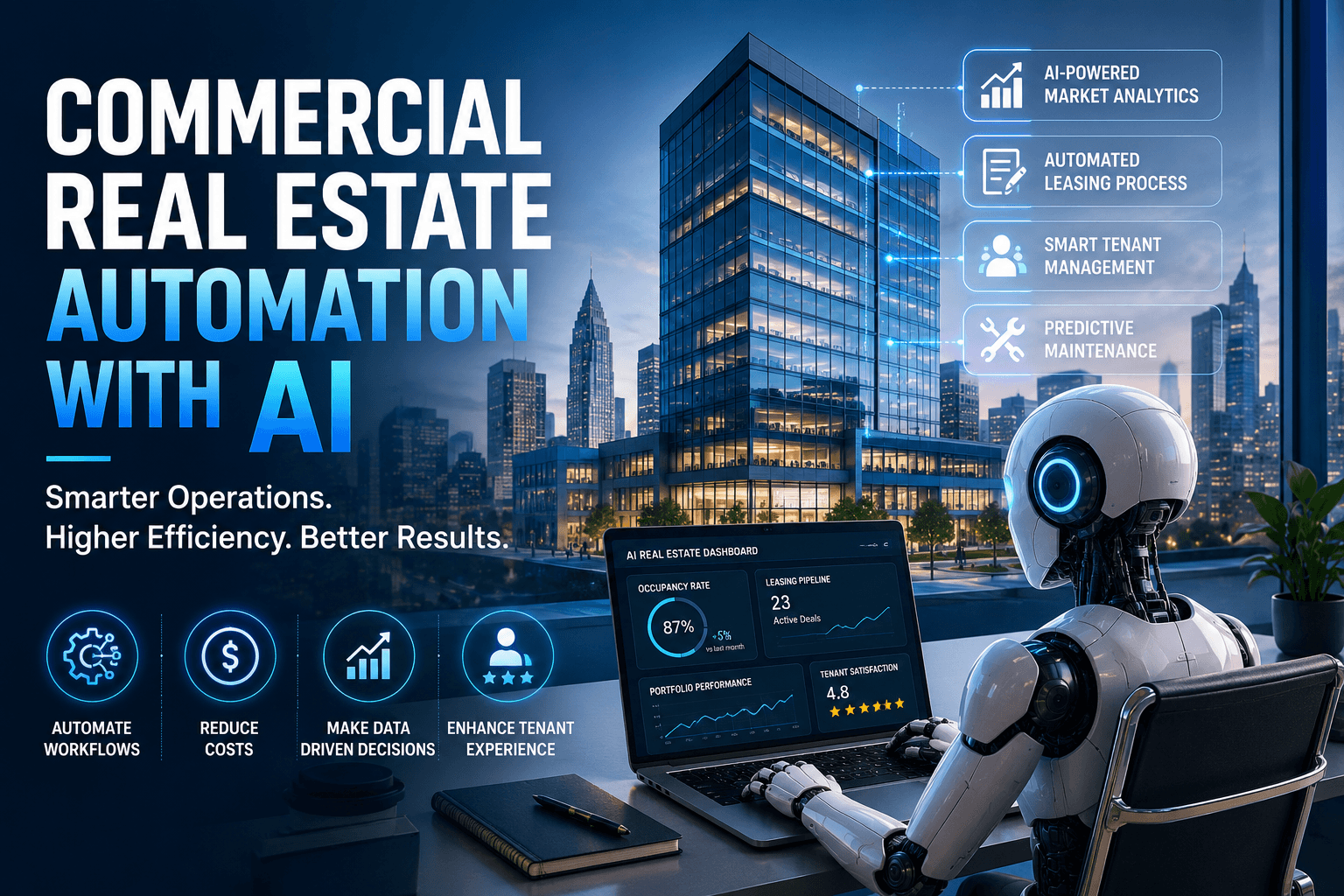
Read More:- Commercial Real Estate Automation with AI
Why CRE is Ripe for Generative AI Disruption
Commercial real estate is one of the most data-heavy yet under-digitized industries. This creates the perfect environment for AI disruption.
Key Challenges in CRE Today
- Manual lease abstraction processes
- Time-consuming financial modeling
- Inefficient tenant communication
- Lack of real-time insights
- Fragmented data systems
- High operational costs
Generative AI addresses these issues by automating repetitive tasks, improving accuracy, and enabling faster decision-making.
Moving Beyond Marketing: The Real Impact of Generative AI
Most companies initially adopt AI for marketing property listings, ad copy, and brochures. But that’s just scratching the surface.
The real ROI comes when AI is embedded into core operations.
Let’s explore how.
1. Lease Abstraction & Document Intelligence
Lease documents in commercial real estate are complex, lengthy, and full of legal jargon.
Traditional Approach:
- Manual review by analysts
- High chances of errors
- Time-consuming (hours per document)
With Generative AI:
- Automatically extracts key terms (rent, escalation clauses, expiry dates)
- Summarizes lease agreements instantly
- Flags anomalies and risks
Impact:
- 80% reduction in processing time
- Improved accuracy
- Faster deal closures
This is one of the most immediate and high-impact use cases of Generative AI in Commercial Real Estate.
2. Financial Modeling & Investment Analysis
CRE investments depend heavily on financial forecasting and risk analysis.
Challenges:
- Complex spreadsheets
- Multiple assumptions
- Time-intensive modeling
AI Transformation:
Generative AI can:
- Build financial models instantly
- Simulate multiple investment scenarios
- Generate ROI projections
- Analyze market trends in real-time
Example Use Case:
An investor can input:
- Property type
- Location
- Budget
And AI generates:
- Cash flow projections
- Risk analysis
- Investment recommendations
Result:
Faster, smarter, and data-driven investment decisions.
3. Property & Asset Management Optimization
Managing multiple commercial properties is operationally intensive.
Pain Points:
- Maintenance scheduling
- Vendor coordination
- Asset performance tracking
AI-Powered Solution:
Generative AI can:
- Predict maintenance needs
- Generate maintenance schedules
- Automate vendor communication
- Provide performance summaries
Benefits:
- Reduced downtime
- Lower maintenance costs
- Improved asset lifecycle management
4. Tenant Experience & Communication Automation
Tenant experience is becoming a major differentiator in CRE.
Traditional Challenges:
- Delayed responses
- Manual communication
- Lack of personalization
With Generative AI:
- AI-powered chatbots for tenant queries
- Automated email responses
- Personalized communication based on tenant behavior
Real Impact:
- Faster response times
- Higher tenant satisfaction
- Increased retention rates
5. Smart Property Search & Recommendation Engines
Finding the right commercial property is complex and time-consuming.
AI Capabilities:
Generative AI can:
- Understand user intent (not just keywords)
- Recommend properties based on preferences
- Generate detailed property comparisons
- Provide location-based insights
Example:
A business searching for office space can get:
- Tailored recommendations
- Budget-based filtering
- Future growth suitability analysis
6. Due Diligence & Risk Assessment
Due diligence is one of the most critical phases in CRE transactions.
Manual Issues:
- Reviewing multiple documents
- Identifying hidden risks
- Time delays
AI Advantage:
Generative AI can:
- Analyze contracts and legal documents
- Identify inconsistencies
- Highlight risk factors
- Generate due diligence reports
Outcome:
- Faster transactions
- Reduced legal risks
- Better compliance
7. Construction & Development Planning
Generative AI is also transforming how commercial projects are planned and executed.
Use Cases:
- Generating architectural concepts
- Optimizing space utilization
- Predicting construction costs
- Timeline forecasting
Impact:
- Reduced project delays
- Cost efficiency
- Better design decisions
8. Data Unification & Insights Generation
One of the biggest challenges in CRE is data silos.
Problem:
Data exists across:
- CRM systems
- Property management tools
- Financial platforms
AI Solution:
Generative AI can:
- Integrate data from multiple sources
- Generate unified dashboards
- Provide actionable insights
Result:
Better strategic decision-making across the organization.
Key Benefits of Generative AI in Commercial Real Estate
The adoption of Generative AI in Commercial Real Estate is no longer just about innovation, it’s about unlocking measurable business value. When implemented across core operations, AI delivers a wide range of benefits that directly impact efficiency, profitability, and long-term growth.
Below are the key advantages explained in depth.
1. Operational Efficiency
Generative AI enhances operational efficiency in commercial real estate by automating repetitive and time-consuming tasks such as document processing, lease management, reporting, and tenant communication. This allows teams to reduce manual effort, minimize delays, and focus on high-value strategic activities that drive business growth.
2. Cost Reduction
By reducing dependency on manual processes and optimizing resource utilization, generative AI helps significantly lower operational costs. From predictive maintenance to automated financial analysis, businesses can identify cost-saving opportunities and eliminate inefficiencies across their real estate operations.
3. Faster Decision-Making
Generative AI enables faster and more informed decision-making by analyzing large volumes of data in real time. It provides actionable insights related to market trends, property performance, and investment opportunities, empowering stakeholders to make quick, data-driven decisions with confidence.
4. Improved Accuracy
With advanced data processing and pattern recognition capabilities, generative AI minimizes human errors and improves the accuracy of reports, forecasts, and property evaluations. This leads to more reliable insights and better risk management in commercial real estate operations.
5. Scalability
Generative AI allows real estate businesses to scale their operations seamlessly without a proportional increase in resources or costs. Whether managing multiple properties or expanding into new markets, AI-driven systems ensure consistent performance and operational efficiency at every stage of growth.
6. Competitive Advantage
Adopting generative AI gives commercial real estate companies a strong competitive edge by enabling innovation, improving customer experiences, and accelerating digital transformation. Businesses that leverage AI can respond faster to market changes and outperform competitors in an increasingly technology-driven landscape.
Challenges & Considerations
While the benefits of generative AI are substantial, its implementation is not without hurdles. Businesses must carefully evaluate various technical, operational, and organizational factors to ensure successful adoption. From managing data quality to navigating regulatory requirements, each challenge plays a critical role in determining the effectiveness of AI-driven initiatives.
1. Data Quality Issues
The success of generative AI largely depends on the accuracy, consistency, and completeness of the data it uses. Poor-quality or biased data can lead to unreliable outputs, flawed insights, and incorrect decision-making. Organizations must ensure proper data cleaning, validation, and governance to build trustworthy AI systems.
2. Integration Complexity
Many organizations operate on outdated infrastructure that lacks compatibility with modern AI technologies. Integrating generative AI into such environments can be complex and resource-intensive, often requiring system upgrades, custom APIs, or even complete digital transformation to ensure seamless functionality.
3. Cost of Implementation
Adopting generative AI involves significant upfront costs, including technology acquisition, infrastructure setup, data preparation, and skilled talent hiring. While the long-term ROI can be substantial, businesses must strategically plan budgets and prioritize high-impact use cases to justify the investment.
4. Regulatory & Compliance Risks
Generative AI systems often process large volumes of sensitive data, making compliance with data protection laws essential. Organizations must implement strong security measures, ensure data privacy, and maintain transparency to avoid legal risks and build trust with users and stakeholders.
5. Change Management
Introducing AI-driven processes requires a shift in mindset across the organization. Employees must be trained to work alongside AI tools, and resistance to change must be managed effectively. Successful adoption depends on clear communication, upskilling initiatives, and fostering a culture that embraces innovation.
How to Implement Generative AI in CRE (Step-by-Step)
Successfully implementing generative AI in Commercial Real Estate (CRE) requires a structured and strategic approach. Rather than rushing into full-scale adoption, businesses should focus on phased implementation starting small, validating outcomes, and then scaling across operations. Below is a step-by-step guide to help organizations integrate generative AI effectively and sustainably.
Step 1: Identify High-Impact Use Cases
The first step is to pinpoint where generative AI can deliver the most value. In CRE, this often includes processes that are time-consuming, repetitive, or data-heavy such as lease abstraction, document analysis, financial forecasting, and market research. By focusing on high-impact use cases, businesses can quickly demonstrate ROI and build momentum for broader AI adoption.
Step 2: Assess Data Readiness
Before implementing AI, it’s essential to evaluate the quality and availability of your data. Generative AI relies heavily on well-organized and accurate datasets. This means cleaning outdated records, removing inconsistencies, and ensuring data is properly structured. Additionally, data should be easily accessible across systems to enable seamless AI integration and real-time insights.
Step 3: Choose the Right Technology Partner
Selecting the right partner can significantly impact the success of your AI initiative. Look for companies with proven expertise in AI development, domain knowledge in real estate, and the ability to deliver scalable solutions. A reliable partner will help you choose the right tools, customize models, and ensure smooth implementation aligned with your business goals.
Step 4: Start Small (Pilot Projects)
Instead of deploying AI across the entire organization at once, begin with a pilot project. This allows you to test the technology in a controlled environment, measure performance, and identify potential challenges. Pilot projects reduce risk, provide valuable insights, and help refine your strategy before full-scale implementation.
Step 5: Train Your Team
Technology alone isn’t enough; your team must be equipped to use it. Provide training sessions, workshops, and ongoing support to help employees understand AI tools and workflows. Encouraging collaboration between technical and non-technical teams will improve adoption and ensure that AI is used to its full potential.
Step 6: Scale Gradually
Once your pilot projects deliver positive results, you can begin scaling AI across different departments and functions. Gradual expansion allows you to maintain control, optimize processes, and ensure consistency. As AI becomes integrated into daily operations, it can drive efficiency, improve decision-making, and create long-term competitive advantages.
Future of Generative AI in Commercial Real Estate
The future is not just about automation it’s about intelligent ecosystems.
We can expect:
- Fully automated property management systems
- AI-driven investment platforms
- Smart buildings with predictive intelligence
- Digital twins for real estate assets
- Hyper-personalized tenant experiences
Generative AI will move from being a tool to becoming a core operational backbone of commercial real estate.
Why Businesses Must Act Now
Waiting is not a strategy anymore.
Companies that delay AI adoption risk:
- Falling behind competitors
- Higher operational costs
- Slower decision-making
- Reduced profitability
On the other hand, early adopters will benefit from:
- Faster growth
- Better efficiency
- Stronger market positioning
Conclusion
Generative AI in Commercial Real Estate is no longer limited to marketing gimmicks it’s fundamentally transforming how the industry operates.
From lease management and financial modeling to tenant experience and asset optimization, AI is redefining efficiency at every level.
The shift is clear:
- From manual processes → automated intelligence
- From reactive decisions → predictive insights
- From fragmented systems → unified ecosystems
For commercial real estate businesses, the question is no longer “Should we adopt AI?”
It’s “How fast can we implement it?”